Before Far Rockaway: The Rockaway Peninsula Before the Resorts
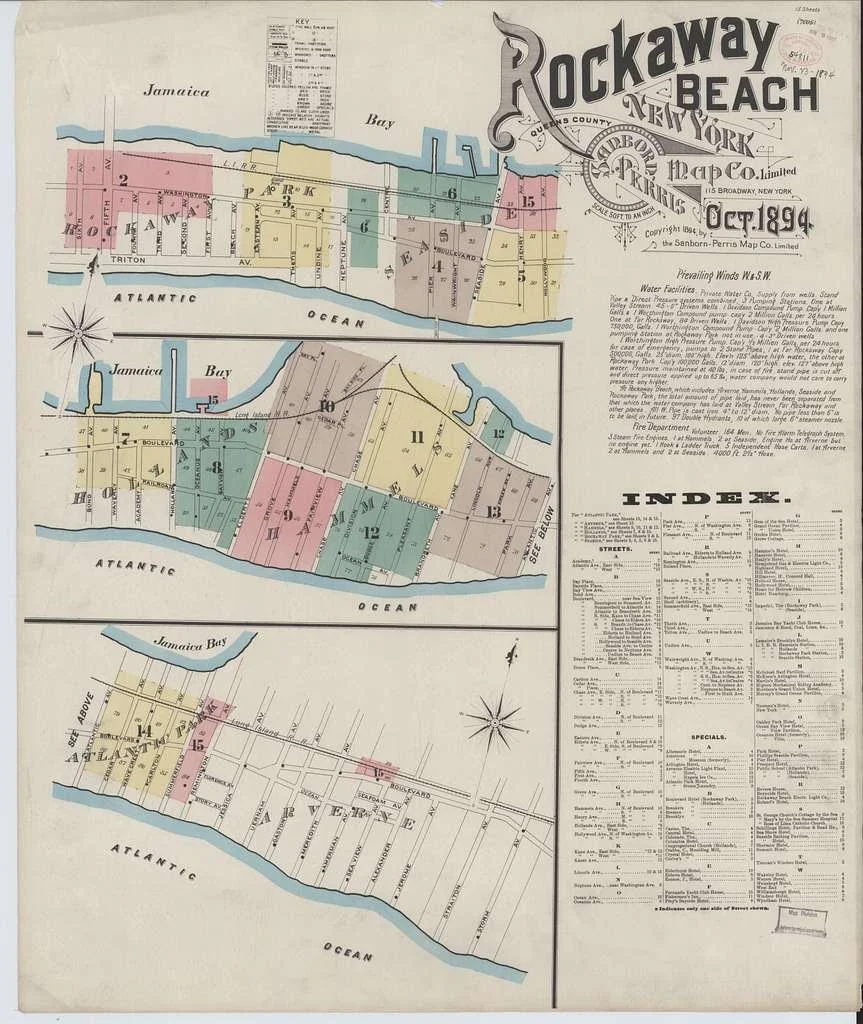
Sanborn Fire Insurance Map of Rockaway Beach, Queens, New York, October 1894.
Far Rockaway is often introduced through the nineteenth century: the Marine Pavilion, railroad expansion, hotels, bungalows, and the long transformation from resort to neighborhood. But the peninsula’s history begins much earlier, in a landscape of dunes, marshes, fishing grounds, and shifting coastal boundaries that supported human life long before any boarding house or station platform appeared.
To understand Far Rockaway properly, it helps to begin before Far Rockaway existed as a named community at all.
The peninsula before urban development
The Rockaway Peninsula was not an empty strip of sand awaiting development. It was a dynamic coastal environment shaped by tides, storms, inlets, bays, and salt marshes. Jamaica Bay and the Atlantic defined its possibilities. The oceanfront offered fish and access; the marshes provided reeds, birds, shellfish, and grazing potential; and the instability of the shoreline meant that land itself was never entirely fixed.1
This environmental history mattered later, when surveyors, developers, and judges tried to impose stable legal lines on a place that naturally shifted over time.
Indigenous Rockaway and coastal life
Before English settlement, the peninsula was associated with Indigenous communities connected to the wider Lenape world. The name “Rockaway” is usually understood to derive from an Indigenous place-name, though spellings and interpretations varied in colonial records. The peninsula formed part of a broader network of seasonal and permanent use tied to fishing, shellfishing, hunting, and movement around Jamaica Bay and the south shore of Long Island.1
Like much of Queens history, this early Indigenous presence was often compressed or obscured in older local narratives that began the story with European land grants. But the geography itself preserves the older reality: this was valuable, inhabited, and understood land before it was subdivided on colonial paper.
Dutch and English claims on the peninsula
As Dutch and then English authority spread across western Long Island, the Rockaway Peninsula entered a world of patents, purchases, and overlapping claims. Colonial officials and settlers saw the peninsula not only as a remote shore but as a potentially profitable tract linked to meadow, livestock, bay resources, and access routes. Coastal property had practical uses long before the leisure economy transformed it.1]
The legal structure imposed by colonial settlement would prove enduring. Questions of title, inheritance, and division became central to Rockaway history because the earliest grants created a framework that later generations repeatedly contested.
Richard Cornell and the beginnings of permanent settlement
One of the foundational figures in Rockaway history is Richard Cornell, the seventeenth-century settler whose holdings became central to later property arrangements on the peninsula. His settlement patterns and descendants shaped the legal and territorial map that would still matter in the nineteenth century, especially in the Cornell partition and later title disputes.[3]
This is one reason the Rockaways are such a rich subject for local history. Resort culture arrived late. Underneath it was an older layer of family landholding, agricultural use, and legal inheritance.
Why the earliest landscape still matters
The pre-resort history of the Rockaways explains several things that come later: why land titles became so contentious, why marsh and beach divisions mattered, and why modern development repeatedly collided with an unstable shoreline. It also reminds us that Far Rockaway was not born as a railroad suburb or beach destination. It emerged out of a much older coastal history.
For a serious Far Rockaway history project, this deeper beginning is essential. Without it, the neighborhood appears suddenly in the nineteenth century. With it, Far Rockaway becomes part of a much longer story about land, ecology, settlement, and memory on the edge of New York.[1
End Notes
Image
Sanborn Map Company. Sanborn Fire Insurance Map from Rockaway Beach, Queens County, New York. Oct. 1894. 15 sheets. Public domain via PICRYL: Sanborn Fire Insurance Map from Rockaway Beach, Queens County, New…
Literary
Grounded in Bellot’s History of the Rockaways, supplemented by articles on broader Rockaway overviews, with some secondary material on Indigenous Jamaica Bay and south-shore Long Island history.1