Secret Societies, Fraternal Orders, and Esoteric Traditions in Queens
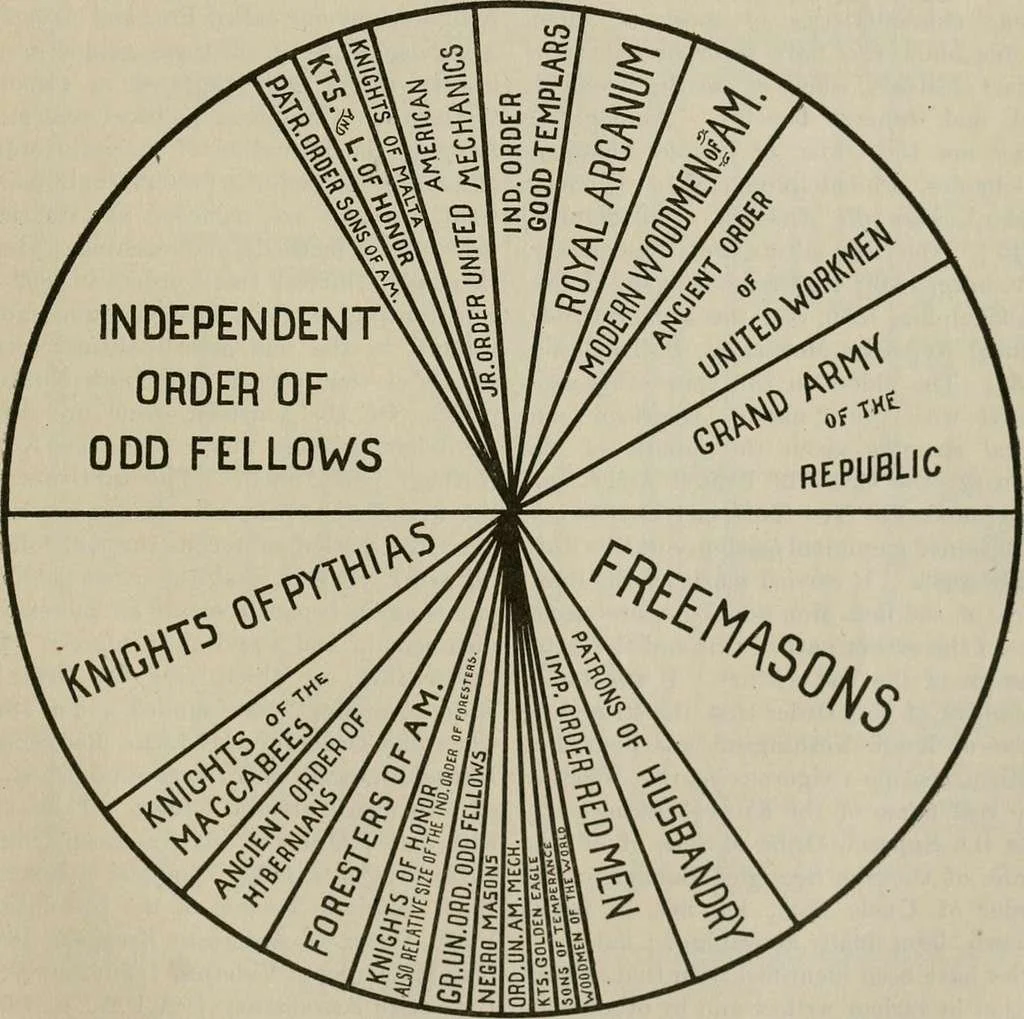
The Cyclopædia of Fraternities, 1899. Public domain.
Queens has long been a borough of joiners. In its villages, railroad suburbs, industrial districts, and growing immigrant communities, residents built a dense network of lodges, councils, courts, temples, clubs, churches, and study groups. Some offered practical aid when illness, unemployment, or death threatened a family. Others created social worlds around banquets, ceremonies, parades, and charity. Still others promised philosophical study, mystical insight, or disciplined self-cultivation.
These organizations are often loosely called “secret societies.” The phrase is useful only if handled carefully. Many did have private rituals, passwords, degrees, officers, regalia, and closed meetings. Yet most Queens fraternal orders were not clandestine in their public role. Their halls hosted dinners, benefits, funerals, concerts, civic meetings, charitable drives, and public commemorations. They were among the borough’s most visible institutions.
The Fraternal Borough
The dominant nineteenth- and early-twentieth-century model was the fraternal-benefit society. Such organizations combined a lodge system, a shared identity, charitable work, and -- often -- sickness, disability, and death benefits. Before Social Scurity, employer health coverage, and modern commercial insurance became widely available, membership could be a practical safeguard for working- and middle-class families. Federal descriptions of fraternal-benefit societies emphasize precisely this combination of a common bond, local lodges, and member benefits.[1]
Queens was particularly suited to this associational culture. As Astoria, Long Island City, Elmhurst, Jamaica, Flushing, Ridgewood, Forest Hills, and the Rockaways expanded, their residents needed places to meet, networks of mutual aid, and institutions that could turn newcomers into established citizens. A lodge did all three.
Freemasonry formed one of the strongest threads in this history. Queens Masonic lodges gave members a structure for fellowship, moral instruction, charitable work, ceremonial life, and civic participation. Local lodges such as Advance Lodge No. 635, Mizpah Lodge No. 738, Island City Lodge No. 586, City Lodge No. 408, and Service Lodge No. 1009 represent the Masonic tradition’s deep roots in the borough.
Freemasonry differed from a simple social club because it used formal degrees, allegory, symbolic instruction, and an initiatory system. Yet mainstream American Masonry was not principally an occult school. Its ritual language was ordinarily presented as moral and philosophical instruction, while its public face centered on fraternity, charity, and civic respectability.
Mutual Aid and Benefit Orders
The Independent Order of Odd Fellows was one of the great American fraternal traditions. Its American branch was founded in Baltimore in 1819 and adopted the familiar watchwords of “Friendship, Love, and Truth.” It used degrees and ritual but also built an extensive culture of mutual assistance, relief, and charitable activity. At its early-1920s height, Odd Fellowship reported more than 2.5 million members around the world.[2][3]
The Knights of Pythias, founded in Washington, D.C., in 1864, drew on the classical story of Damon and Pythias to teach friendship, loyalty, charity, and benevolence. Its local lodges offered members the same mix of ceremony, sociability, charity, and benefit-oriented culture that made fraternalism central to urban life after the Civil War. New York archival records preserve Pythian lodge minutes, financial books, annual reports, death-claim materials, and beneficiary applications—evidence that the order’s ritual life was tied to concrete support for members and their families.[4][5]
The Benevolent and Protective Order of Elks was one of the most publicly prominent fraternal institutions in Queens. Queensboro Lodge No. 878 was founded in 1903 and later developed its imposing clubhouse at 82-10/82-20 Queens Boulevard in Elmhurst. The complex included a theater, guest rooms, banquet facilities, bars, recreation rooms, and a bowling alley; at its height, the lodge reportedly reached 6,600 members in the 1960s.[6][7]
The building’s later history tells the broader story of the decline of the lodge age. Membership fell, maintenance costs rose, and the Elks sold the main Elmhurst building to New Life Fellowship Church in 2001. The Brooklyn Queensborough Elks Lodge nonetheless continues to meet in the annex at 82-20 Queens Boulevard.[7][8]
Other comparable orders warrant systematic Queens research:
- The Ancient Order of United Workmen, one of the earliest major American fraternal-benefit societies.
- The Independent Order of Foresters, organized in North America in 1874 and associated with courts, insurance, death benefits, and charitable work.
- The Modern Woodmen of America and related Woodmen organizations, which paired fraternal ritual with insurance and family protection.
- The Maccabees, a major benefit order founded in 1883.
- The Improved Order of Red Men, a ritual fraternity that appropriated Indigenous imagery and terminology.
- Women’s and family-related bodies, including the Order of the Eastern Star and the Daughters of Rebekah.
- Ethnic and religious mutual-aid organizations, including Catholic, Jewish, Italian-American, German-American, Irish-American, and other community-based societies.
These bodies were not identical in belief or membership. What united them was the belief that a person could secure dignity, aid, and social standing through disciplined membership in a local association.
Royal Arcanum and Arcanum Hall
The Royal Arcanum deserves special attention in Queens. Founded in Boston in 1877, it was a fraternal-benefit society created to protect members’ families through collective insurance and death benefits. Its stated purposes also included fellowship, moral and material aid, educational loans, annuities, and assistance to the families of deceased members.[9][10]
Its local units were typically called councils. The name Arcanum Hall in Elmhurst therefore points toward the practical benefit-society culture of the Royal Arcanum, not necessarily toward occultism or mysterious hidden teachings.
Arcanum Hall on Broadway was also a valuable example of shared fraternal infrastructure. Mizpah Lodge No. 738 met there beginning in 1905. Forest Hills Lodge No. 946 also met there before moving into its purpose-built Queens Boulevard temple in November 1920. A hall associated with one order could thus become an early home for another, helping newer organizations build membership and resources before they could establish a permanent temple.[11][12]
The Royal Arcanum’s history confirms a broader pattern: fraternal organizations did not exist only to perform ritual. They developed because ordinary families faced serious financial risk in an era before reliable public welfare systems and widespread workplace benefits.[9]
Foresters and Free Gardeners
The Foresters were part of the same broad world of mutual aid, though the name can refer to more than one related tradition. The Ancient Order of Foresters emerged from British friendly-society culture, while the Independent Order of Foresters became an important North American fraternal-benefit organization. Their local bodies were often called courts, and their symbolism drew on woodland imagery, rangers, axes, and the moral idea of fellowship in a forest.
Like the Royal Arcanum, the Foresters joined ritual fellowship to material protection. The organization’s insurance dimension remains reflected in New York State’s treatment of the Independent Order of Foresters as a fraternal-benefit society. Period Queens research should therefore search not only for “Foresters,” but also for “I.O.F.,” “court,” “chief ranger,” “high chief ranger,” “Foresters’ picnic,” and “Foresters’ benefit.”[13]
The Order of Free Gardeners belongs to a more elusive category. It originated in Scotland in the seventeenth century and spread through Scotland, England, and Ireland. Its ritual system used gardening imagery and degrees associated with biblical figures such as Adam, Noah, and Solomon.[14][15]
A Free Gardeners presence in Queens is possible, particularly given the borough’s British and Irish immigrant connections. At present, however, there is no verified Queens lodge, hall, membership list, or newspaper reference establishing that it was a local institutional presence. Until such evidence is found, it should be treated as part of the transatlantic background of friendly societies -- not as a documented Queens order.
Esoteric and Occult Orders
Rosicrucian, Theosophical, Golden Dawn, and O.T.O. traditions belong to a different family of organizations. They may also use degrees, symbols, private ritual, titles, and restricted teachings. The essential difference is their goal: rather than operating primarily as neighborhood benefit societies, they focus on spiritual inquiry, mystical philosophy, occult study, ceremonial practice, or personal transformation.
The modern Rosicrucian movement traces its symbolic ancestry to early-modern European manifestos about a hidden brotherhood of philosophical and spiritual wisdom. Modern Rosicrucian bodies vary in character, but the best-known American organization, AMORC—the Ancient and Mystical Order Rosae Crucis -- describes itself as a worldwide philosophical community concerned with spiritual wisdom, self-discovery, practical mysticism, and the evolution of consciousness.[16][17]
The Theosophical Society, founded in New York City in 1875 by Helena P. Blavatsky, Henry Steel Olcott, William Quan Judge, and others, helped popularize a broad Western interest in Eastern religious traditions, comparative religion, spiritualism, and esoteric philosophy. Its New York roots make it important background for the metropolitan intellectual environment that later influenced spiritual and occult study groups throughout the region. A direct historic Queens branch or meeting place, however, requires separate documentation.[18][19]
The Hermetic Order of the Golden Dawn was a British occult order founded in the late nineteenth century. It organized a graded course of study in ceremonial magic, Hermetic philosophy, Kabbalah, astrology, Tarot, and alchemy. Its successors and related groups have had a broad cultural influence, but a historic Queens presence should not be assumed without evidence of a temple, officers, meeting notices, correspondence address, or local membership.[20]
The Ordo Templi Orientis, or O.T.O., is another esoteric initiatic order, best known through its association with Aleister Crowley and Thelema. Its degrees and rituals are intended to convey a distinctive occult and philosophical system. It is best understood as an esoteric initiatic order, not as a fraternal-benefit society akin to the Royal Arcanum or Foresters.
The difference can be stated simply: a Royal Arcanum council existed chiefly to unite members and provide social and material protection; a Rosicrucian, Golden Dawn, or O.T.O. body existed chiefly to transmit a spiritual, philosophical, or magical curriculum.
Martialism and the Disciplined Body
Martialism adds another dimension to Queens’ history of organized identity. Here, the word refers not simply to martial arts training but to a broader culture that values discipline, hierarchy, physical skill, uniform, ceremony, preparedness, comradeship, and sometimes patriotic or military ideals.
Martial culture has often overlapped with fraternal culture. Veterans’ posts, rifle clubs, drill teams, ethnic military societies, athletic clubs, police and firefighter associations, and martial-arts schools all create bonds through repeated training, shared symbols, rank, ceremony, and collective identity. They may not be secret societies, but they can perform many of the same social functions: fellowship, mentoring, mutual support, public display, and the formation of character.
Queens’ later martial-arts landscape reflects the borough’s extraordinary diversity. Schools representing Japanese, Chinese, Korean, Filipino, Brazilian, and hybrid traditions have provided not only self-defense instruction but intergenerational community, cultural transmission, physical discipline, and a structured path of advancement. Present-day Queens examples include schools teaching Jeet Kune Do, Filipino Kali, and Brazilian jiu-jitsu, demonstrating how martial culture continues to create durable voluntary communities in the borough.[21][22][23]
For historical purposes, martialism should be treated as adjacent to—not identical with—fraternalism. A lodge typically bound members through ritual fellowship and charitable obligation. A martial group more often bound participants through training, physical discipline, rank, performance, and the ethics of controlled force. Both, however, helped people find belonging in an immense and changing city.
What Declined—and What Endured
The great lodge age began to fade after the mid-twentieth century. Public welfare programs, commercial insurance, workplace benefits, suburban mobility, television, changing leisure habits, rising building costs, and the collapse of traditional neighborhood social patterns weakened organizations that had once been indispensable.
Many orders survived, but in altered form. Some consolidated lodges. Some sold their temples. Some retained their rituals while reducing their public social programs. Others reinvented themselves as charitable organizations, heritage institutions, community clubs, or smaller fellowship groups.
Their legacy remains visible in Queens:
- Surviving lodges and councils.
- Former temples, clubhouses, and halls adapted for churches, apartments, commercial use, or community facilities.
- Cornerstones, regalia, photographs, newspapers, minute books, insurance records, and cemetery monuments.
- The continuing human need for fellowship, ritual, identity, discipline, charity, and mutual support.
Queens’ many lodges, courts, councils, temples, and study groups demonstrate that voluntary association was never a side story. It was one of the borough’s principal ways of building community.
End Notes
Author’s note:
I write as an individual Freemason, historian, and researcher. This article reflects my personal research and interpretation and does not represent an official statement of Advance Service Mizpah Lodge No. 586, the Grand Lodge of New York, or any other Masonic organization.
Literary:
Albert Clark Stevens, The Cyclopædia of Fraternities: A Compilation of Existing Authentic Information and the Results of Original Investigation as to More Than Six Hundred Secret Societies in the United States, 1899, New York City and Paterson, N.J.: Hamilton Printing and Publishing Company; digitized by the University of California Libraries; public domain; via Wikimedia Commons/PICRYL.