What an Egregore Really Is
How a shared idea becomes a social force, and why the old occult term still explains modern life remarkably well.
Every age invents a fresh vocabulary for very old experiences. Ours prefers words like branding, narrative, identity, culture, memetics, and social contagion. Earlier generations, being less shy about invisible things, often used a different term: egregore.
Now, the trouble with old occult words is that they tend to attract two equal and opposite errors. One camp hears them and rolls its eyes so hard it risks a retinal injury. The other hears them and immediately starts talking as if every logo, mascot, and lodge room is haunted by a sentient weather system from the astral plane.
Both reactions are unhelpful.
An egregore, at minimum, names a real phenomenon: a group-generated field of meaning, emotion, habit, and expectation that grows stronger as people feed it with attention, ritual, and belief. Whether one understands that force as metaphysical, psychological, social, or some combination of the three, the effects are not hard to spot. Institutions develop a presence. Nations acquire personalities. Brands start behaving like minor gods. Organizations begin to shape the people who supposedly run them.
And if that sounds dramatic, it is only because people prefer to imagine they are acting freely when they are mostly swimming in ideas they did not personally invent.
The old word still matters because the thing it names still matters.
The older meaning: thought made durable
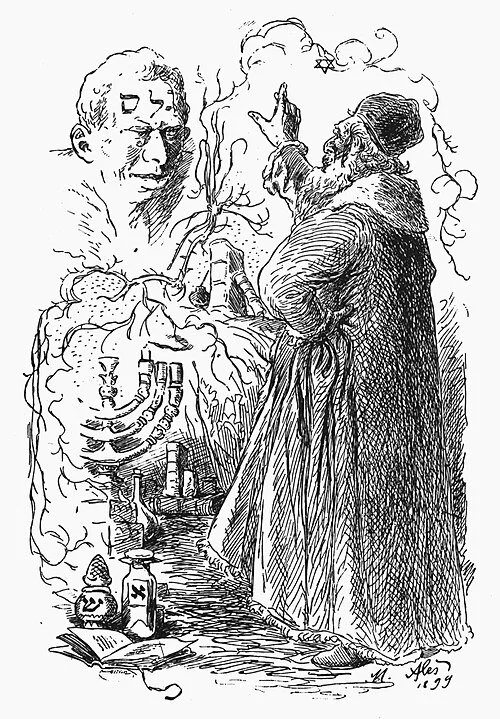
In the older occult literature, an egregore is usually described as a group-created thoughtform: a living psychic structure generated by repeated focus around a common symbol, purpose, or being. The concept overlaps with the Tibetan idea of the tulpa, though tulpas are more often described as individually generated while egregores are collective in origin.[1]
That distinction is useful. One person can obsessively imagine an inner companion. A group can build something larger: a shared atmosphere, an organizing intelligence, a symbolic center that outlasts any one member. In both cases, mind is not treated as a sealed box. It spills over. It takes shape. It does things.
Annie Besant and C. W. Leadbeater, in their curious and influential little book Thought-Forms, argued that thought is not some ghostly vapor that politely disappears after use. Thought, they insisted, has form, color, direction, and consequence.[2] You need not accept their clairvoyant color charts to grasp the larger point. Repeated thoughts affect the thinker. Shared thoughts affect groups. Organized thoughts affect history.
This should not be controversial. We already believe a slogan can move a crowd, a myth can sustain a nation, and a liturgy can form a conscience. We only become nervous when someone uses an unfashionable noun.
The secular translation: culture with teeth
Suppose we avoid all metaphysical claims for a moment. The egregore remains perfectly serviceable.
A modern social scientist might speak of collective representations, social imaginaries, group identity, institutional culture, mass formation, emergent behavior, or memetic reinforcement. Durkheim would point to the way societies project sacred force onto shared symbols.[3] Jung would note how archetypal images can behave with eerie autonomy in the psyche.[4] Contemporary psychology would discuss attentional learning, absorption, projection, and social contagion.[5]
Different vocabulary, same general shape.
A strong egregore, in secular terms, is a socially maintained pattern that:
- organizes attention
- shapes feeling
- rewards conformity
- punishes deviation
- reinforces itself through symbols and ritual
- begins to feel larger than any one person inside it
That last point is the important one. People start saying things like:
- “That’s just how this place is.”
- “The movement won’t tolerate it.”
- “The brand would never do that.”
- “The Lodge will deal with him.”
- “The institution has a way of correcting things.”
At that point, the group has ceased to be merely a collection of individuals. It has become a presence in the minds of its members. Whether one calls that culture or egregore depends mostly on one’s taste in nouns.
Advertising figured this out long ago
If you want to see egregoric mechanics at work without incense, look at modern branding.
A successful brand is not merely a seller of goods. It is a symbolic machine. It trains emotion to attach itself to colors, logos, stories, founders, launch rituals, slogans, and tribal belonging. The product matters, certainly. But the halo matters more.
People do not merely buy shoes. They buy aspiration, rebellion, taste, virtue, ruggedness, genius, authenticity, or coolness. The logo becomes an icon. The launch becomes a feast day. The founder becomes a saint or a rebel prophet, depending on market segment.
At that point, the brand functions like a secular cult object. Not because someone in the boardroom read Eliphas Lévi by candlelight, but because repetition, symbolism, and emotional investment naturally produce egregore-like effects.
It would be funny if it were not so profitable.
Politics is even less subtle
Politics does not merely persuade. It enthrones symbols.
A political egregore is built from:
- sacred language
- repeated phrases
- heroes and martyrs
- enemies and traitors
- ritual gestures
- narratives of doom or redemption
- emotional participation stronger than private judgment
This is why movements can survive bad predictions, failed policies, and embarrassing facts. The movement is no longer held together chiefly by evidence. It is held together by identity, belonging, and symbolic investment. Contradiction does not dissolve it. Contradiction may actually strengthen it, if it intensifies loyalty.
Once that happens, argument becomes difficult. One is no longer debating a claim. One is threatening a habitat.
Religion, institutions, and the spirit of the place
Religious people will often describe an egregoric effect as a living tradition, a spirit of a people, a guardian presence, or, depending on theology, something more angelic or more dangerous.
Skeptics will call it collective meaning stabilized through ritual.
Again, the practical mechanism overlaps. Repetition matters. Posture matters. architecture matters. Language matters. Symbols matter. Shared silence matters. So does music, clothing, rhythm, and expectation.
Anyone who has entered a room and immediately felt that it was tense, noble, decayed, alive, dead, reverent, corrupt, serious, or unserious already knows this. Human beings are symbol-making animals, and symbols are not decorative. They are organizing devices.
They tell the nervous system how to behave.
Why this matters for fraternal life
This becomes especially relevant in fraternal, initiatic, and ritual organizations.
People often say a lodge, chapter, church, regiment, or order has an atmosphere. That word is not bad, but it is a little weak. Atmosphere sounds like weather. What they usually mean is something more active: a moral-psychic ecology built over time by the thoughts, conduct, standards, devotions, evasions, habits, and aspirations of its members.
That is much closer to what older writers meant by an egregore.
And here one important correction must be made: an egregore is not a magical janitor.
It is not a ready-made invisible custodian that arrives with the charter, polishes the furniture, corrects bad men, improves ritual, and drives out fools while the members sit on their hands. That notion is not esoteric wisdom. It is spiritualized laziness.
If a lodge, church, or order feeds its collective life with vanity, cowardice, sloppy work, faction, and avoidance, then the thing it builds will bear exactly those traits. If it feeds steadiness, reverence, truthfulness, and disciplined participation, it will tend in a different direction.
Which is to say: whatever else an egregore may be, it is not exempt from the character of its makers.
In Closing
That is the first thing to understand. The egregore is not merely an odd relic from occult literature. It is a useful name for a force most people already experience but do not know how to describe.
The second thing to understand is more uncomfortable: once a group generates such a force, it does not simply reflect the group. It begins to shape the group in return.
That is where the matter becomes practical. And that is where we turn next.
Endnotes
- [1] Alexandra David-Néel, Magic and Mystery in Tibet (London: Souvenir Press; orig. French 1929). See also David-Néel, Initiations and Initiates in Tibet.
- [2] Annie Besant and C. W. Leadbeater, Thought-Forms (London: Theosophical Publishing Society, 1905).
- [3] Émile Durkheim, The Elementary Forms of Religious Life, trans. Karen E. Fields (New York: Free Press, 1995; orig. 1912).
- [4] C. G. Jung, The Archetypes and the Collective Unconscious, Collected Works Vol. 9, Part 1, trans. R. F. C. Hull (Princeton: Princeton University Press, 1981).
- [5] T. M. Luhrmann, When God Talks Back: Understanding the American Evangelical Relationship with God (New York: Knopf, 2012); T. M. Luhrmann et al., “Learning to Discern the Voices of Gods, Spirits, Tulpas, and the Dead,” Schizophrenia Bulletin 49, no. 1 (2023): S3–S12.