Background to Before the Borough: The First Masonic Lodges of Queens · ← Previous: Where the First Queens Lodges Met · Next: How the Grand Lodge of New York Began →
The first Masonic lodges known to have met in Brooklyn were not local lodges at all. They were regimental lodges carried in the baggage of the British army.
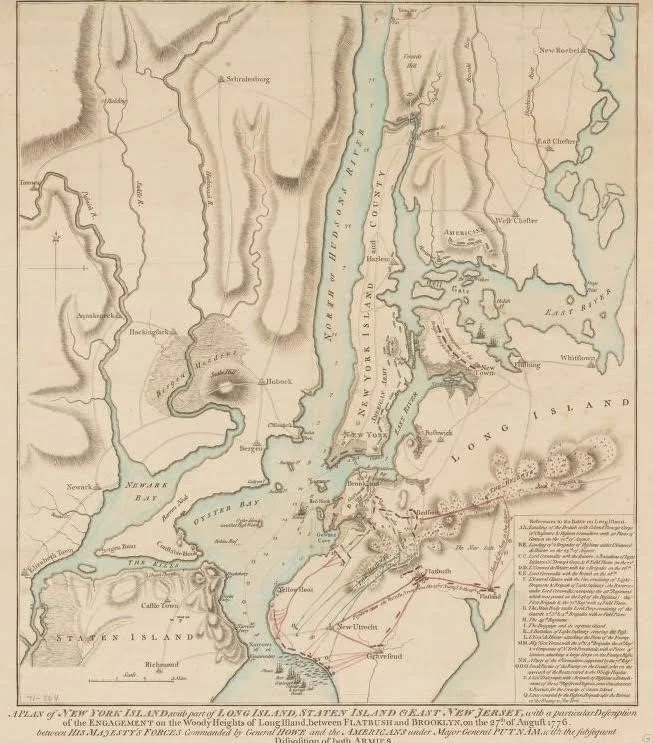
The first Masonic lodges known to have met in Brooklyn traveled with British, Irish, Scottish and German units. Those units fought the Battle of Long Island in August 1776 and then occupied Kings and Queens counties until the evacuation of 1783. A modern compilation places several of these lodges in camp at Bedford, in Brooklyn, in 1778. No source found so far places a military lodge in a Queens town by name.
The Occupation
After the British victory at the Battle of Long Island on August 27, 1776, New York City and Long Island stayed under British occupation until the final evacuation in 1783. Troops were quartered across the island. An American report to Washington in January 1779 estimated about 3,380 British and allied troops on Long Island, not counting DeLancey's Brigade and the cavalry (Journal of the American Revolution). John Graves Simcoe turned Oyster Bay, then in Queens County, into an armed camp, and the third battalion of DeLancey's Loyalist brigade held Fort Franklin on Lloyd's Neck from 1778 to 1780 (Journal of the American Revolution).
How a Military Lodge Worked
A regimental lodge held a "traveling warrant" from a Grand Lodge in England, Ireland or Scotland, or from a provincial Grand Lodge. The warrant moved with the regiment, and the lodge met wherever the regiment camped or wintered. Officers and men could be made Masons there, and sometimes local civilians were too. The Grand Lodge of Ireland was especially generous with these warrants, which is why so many of the lodge numbers below are Irish.
Regimental Lodges With Brooklyn Connections
The most useful modern list is Gary L. Heinmiller's Loyalist Freemasons from the State of New York (2010), which draws on the Transactions of the American Lodge of Research, vol. 12, no. 2 (1973).
| Lodge No. | Regiment | Warrant | Brooklyn connection |
| --- | --- | --- | --- |
| 52 | 37th Foot | Ancients, 1756 | Battle of Brooklyn; camp at Bedford, 1778 |
| 195 | 42nd Highlanders | Ireland, 1749 | Staten Island and Brooklyn, 1776; camp at Bedford, 1778 |
| 227 | 46th Foot | Ireland, 1752 | Battle of Brooklyn; camp at Bedford, 1778 |
| 43 (St. Patrick's) | 43rd Foot (as listed) | Ireland, 1769 | Camp "on the outskirts of Brooklyn," 1780 |
| 441 | 38th Foot | Ireland, 1765 | Occupation of New York; left with the regiment in 1783 |
| 132 (Moriah) | 22nd Foot | Scotland, 1767 | Occupation of New York; left at the evacuation |
The same list ties many more regimental lodges to the Battle of Brooklyn itself, among them lodges in the 4th, 5th, 10th, 15th, 23rd, 27th, 28th, 33rd, 35th, 40th, 45th, 49th, 52nd, 57th, 63rd and 64th regiments. Those lodges passed through Brooklyn with the army. The Bedford entries are the ones that suggest lodges actually meeting in camp there.
Lodge No. 441 has a wider fame. Before the war, in Boston, it initiated Prince Hall and fourteen other free Black men on March 6, 1775, the origin of Prince Hall Freemasonry (Prince Hall Grand Lodge of New York). Its regiment, the 38th Foot, later served in the New York garrison.
The American Side
The Continental Army had military lodges too. American Union Lodge, chartered in February 1776, was stationed on Long Island that summer and kept meeting. Several of its members were killed or captured in the Battle of Brooklyn (American Union Lodge No. 1). For a few weeks in 1776, lodges on both sides were at work on the same ground.
From Camp Lodges to a Grand Lodge
The military lodges in New York City did more than meet. In 1781 several of them joined to found the Provincial Grand Lodge that became today's Grand Lodge of New York. The Masonic historian R. F. Gould wrote in 1880 that the Grand Lodge of New York "in its inception, was a purely Military body." He listed Lodge No. 169, "the leading Army Lodge," along with lodges in the 37th, 22nd, 38th and 57th regiments and a German Brandenburg regiment (The Freemason's Chronicle, July 10, 1880). That story is told in How the Grand Lodge of New York Began Under British Occupation.
What We Still Don't Know
Queens towns. No source yet places a regimental lodge at Jamaica, Flushing, Newtown, Hempstead or Oyster Bay, though troops were quartered across the island throughout the war.
Hessian and Loyalist lodges. Lodge No. 215 served in a Brandenburg-Anspach regiment, and a lodge numbered 7 in the Loyal American Regiment. Whether either met on Long Island is not known.
Local men. Whether any Long Islanders were made Masons in a military lodge during the occupation remains an open question.
Sources
Journal of the American Revolution, "Quartering British Forces on Long Island" (2023) and "Fort Franklin: Tory Bastion on Long Island Sound" (2015).
Gary L. Heinmiller, Loyalist Freemasons from the State of New York (2010), drawing on Transactions of the American Lodge of Research, vol. 12, no. 2 (1973), pp. 208 to 236.
Prince Hall Grand Lodge of New York, history.
R. F. Gould, "Military Lodges", The Freemason's Chronicle, July 10, 1880.
James R. Case, "American Masonic Roots in British Military Lodges" (1965).
