The liberal arts, Plato’s ascent, and why education is more than information
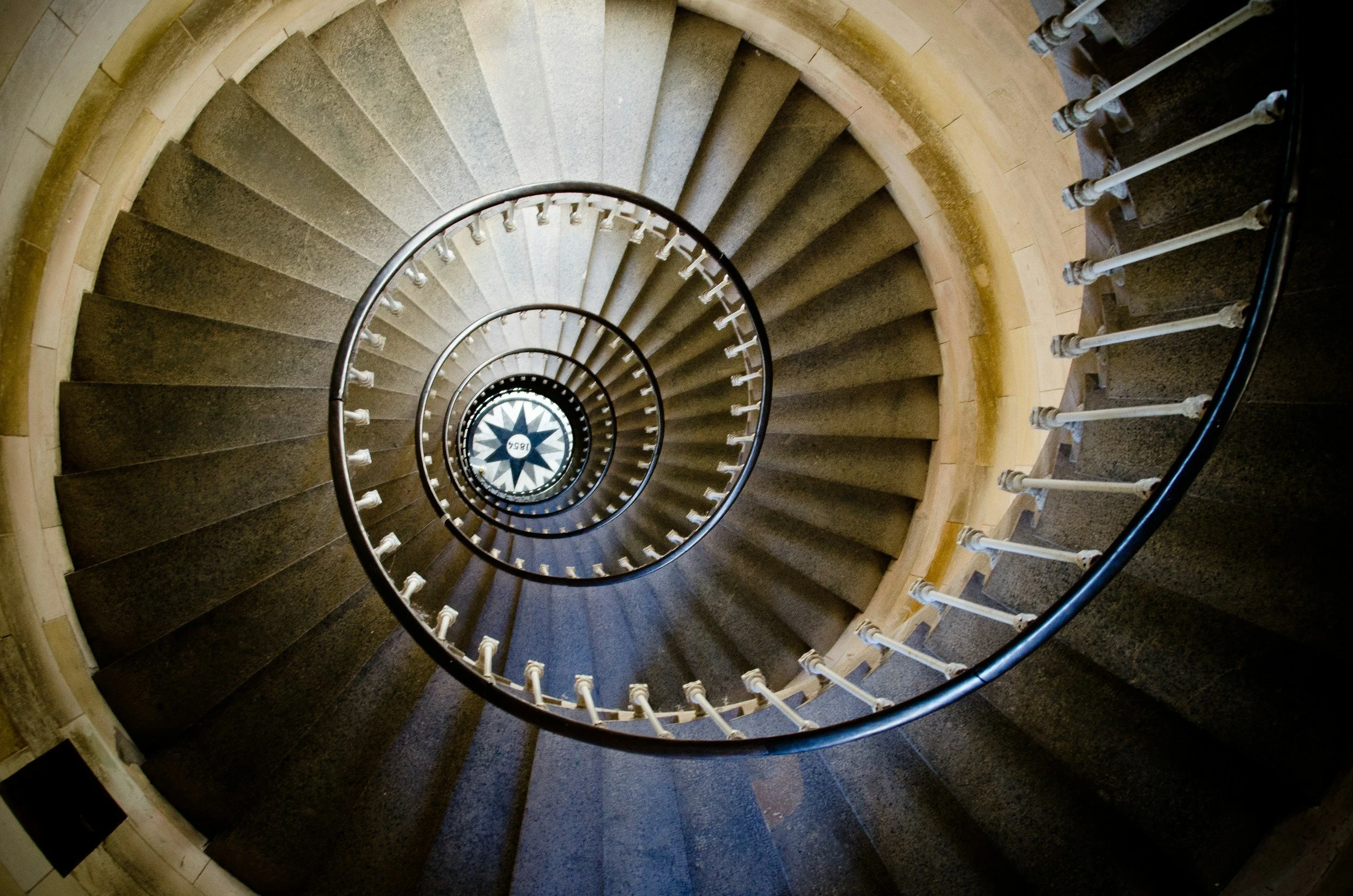
The Middle Chamber is not merely a destination in a degree. Read philosophically, it is a condition of mind: the patient ascent from memorized words toward judgment, proportion and self-knowledge.
A staircase is not an education.
It is possible to climb a staircase while thinking about lunch. It is possible to reach the top while learning nothing except that one's knees have become opinionated. The physical act of ascent does not automatically improve the mind.
And yet the image of ascent has lasted for good reason. It expresses something true about education: a person does not acquire knowledge the way one acquires furniture. He rises, slowly and with effort, into new habits of attention.
The Middle Chamber, considered philosophically, can be read as an image of this ascent. It is not merely a room at the end of a symbolic journey. It is the cultivated mind, the mind that has moved beyond noise, appetite, vanity and memorized language toward judgment, proportion and the ability to see relations between things.
That kind of chamber cannot be entered by being told where the door is.
Education is a turning
Plato's Cave gives us the first principle.
Education, Plato says, is not putting knowledge into a soul that has none. It is turning the soul toward what it is already capable of seeing. The prisoner has eyes, but they are directed toward shadows. The work of education is to turn him around.[1] In the same book Plato sketches a course of study that runs through arithmetic, geometry, astronomy and harmony before it reaches dialectic.[2]
This is a much richer idea than the modern picture of learning as information transfer.
A person can possess facts and still lack judgment. He can read quickly, quote extensively, and remain unable to distinguish evidence from assertion, confidence from competence, symbolism from superstition, or a clever remark from an argument.
The educated mind is not simply full. It is ordered.
It has learned to ask:
- What do I know?
- How do I know it?
- What follows from it?
- What does not follow from it?
- What might I be overlooking?
- What is the proper scale of this problem?
- What is the difference between a fact, an interpretation and a wish?
This is why the old liberal arts matter. They are not relics from a time when people wore more wool. They are disciplines of attention.
Grammar: the discipline of saying what one means
Grammar is often treated as a minor schoolroom nuisance, somewhere between a dull pencil and an unfortunate spelling test.
But grammar is moral equipment.
To speak imprecisely is often to think imprecisely. To use words carelessly is to make it easier for oneself and others to be manipulated. A person who cannot distinguish "is" from "might be," "evidence" from "claim," or "I dislike this" from "this is false" is not merely making a grammatical error. He is losing track of reality.
Grammar teaches respect for meaning.
A Mason interested in Light should care about this. Ritual language, obligations, charges and symbols all depend upon words. To speak them casually is to treat moral instruction as decoration. To understand them carefully is to begin asking what they require in life beyond the lodge room.
Rhetoric: the moral burden of persuasion
Rhetoric is the art of persuasion. It is also one of the most dangerous tools ever placed in human hands.
A good speaker can clarify truth. He can encourage courage, reconcile enemies, defend the weak, inspire service, and help a community understand what it ought to do.
A bad speaker can make nonsense sound noble and cruelty sound necessary.
The study of rhetoric therefore asks more than "How can I speak effectively?" It asks "What should I persuade people to do?" A person who learns only how to win an argument has learned something useful and potentially disastrous.
The Masonic connection is immediate. A lodge depends upon speech: charges, lectures, motions, remarks, condolences, instruction, fellowship. Speech can build trust or dissolve it. It can elevate a room or turn it into a small theater of ego.
The educated speaker learns that words are tools. Tools should not be swung merely because one enjoys the sound they make.
Logic: the quiet enemy of nonsense
Logic is not the art of winning arguments by saying "fallacy" in a confident voice.
It is the discipline of following thought where it actually leads.
Logic teaches a person to distinguish cause from coincidence, premise from conclusion, statement from proof, and disagreement from contradiction. It trains the mind to notice when an argument is skipping steps, changing definitions, appealing to emotion, or demanding more belief than the evidence permits.
This is not a cold or bloodless skill. It is a form of charity.
The person who thinks clearly is less likely to accuse unjustly, panic needlessly, spread rumors, or mistake a passing emotion for a permanent moral law. Logic helps keep the mind from becoming another cave in which shadows shout at one another.
Arithmetic and geometry: the education of proportion
Arithmetic teaches number. Geometry teaches form, relation, measure and proportion.
The moral value of these subjects is not that every person must become a surveyor or solve equations at social gatherings. Their deeper lesson is that reality has structure. Things stand in relation to one another. Size matters. Measure matters. Proportion matters.
A person who has learned something from geometry may be less likely to mistake a small grievance for a life-defining catastrophe. He may understand that a part is not the whole, that a line may look straight from one angle and not from another, and that a building collapses when its elements are not properly related.
This is part of why geometry carries so much weight in Masonic symbolism. It offers a visible language of order. It reminds us that construction is not random piling. A wall, an arch, a temple and a life all require relation among their parts.
A man may have strong materials. If he places them badly, he still builds a ruin.
Music: learning that harmony is not sameness
Music teaches ratio, rhythm, tension, release, harmony and proportion in time.
It also teaches a lesson badly needed in every lodge, family, committee, neighborhood and civilization: harmony is not sameness.
A chord is not a single note played repeatedly by people who have agreed never to disagree. It is distinct notes held in proper relation. The notes keep their character. Their relation creates consonance.
The same is true of fellowship. The point is not to gather identical people, gifts, opinions or temperaments. The point is to create conditions in which difference contributes to a common good rather than dissolving into vanity, faction or resentment.
Orpheus on the Argo matters for this reason. A ship full of heroes requires more than strength. It requires harmony.
A lodge does too.
Astronomy: the cure for provincial self-importance
Astronomy directs the eye upward.
This is not merely sentimental. To study the heavens is to become aware of scale, order, motion, and realities that do not reorganize themselves around one's current inconvenience.
A man who looks at the stars may still be vain. Human beings are remarkably adaptable. But astronomy makes vanity harder to sustain without effort.
The heavens remind us that our crises, while real, are not always cosmic. They also remind us that the world is more ordered, strange, vast and beautiful than the narrow circuit of our daily anxieties suggests.
For the Platonic mind, this is educational. The soul is trained to look beyond immediate appetite and private advantage toward order itself.
For the Mason, the starry canopy becomes more than attractive ceiling decoration. It becomes a summons to humility and wonder.
A careful Masonic resonance
The connection to the Second Degree should be stated plainly but carefully.
There is no need to claim that Plato's educational program became Masonic ritual in a direct historical line. The traditions are distinct. Yet both hold that a person becomes more capable through disciplined ascent. Both give the liberal arts and sciences a place of honor. Both use symbolic movement to suggest intellectual and moral advancement. And both imply that the person who climbs should become more useful, not merely more impressed with his elevation.
The chamber is built by use
The liberal arts do not make a person wise automatically. A dishonest man can study grammar. A selfish man can learn logic. A fool can memorize astronomy. Education without character merely produces more capable versions of old problems.
But properly pursued, the arts form habits of mind that make wisdom more possible.
They train precision, proportion, patience, attention, memory, discrimination and reverence for truth. They make a person less captive to the loudest voice, the easiest explanation, the nearest pleasure, or the most flattering interpretation.
Later Platonists described virtue as a ladder, running from the civic virtues that govern ordinary conduct up through purificatory and contemplative ones.[3][4] On that picture, the arts are best read as preparation: the work that makes the higher rungs reachable at all.
This is the Middle Chamber of the mind.
It is not a place where one stores impressive information. It is a place where one learns to govern attention.
The staircase remains symbolic only until a man begins the climb.
Notes
- Plato, Republic VII, 518c–d, on education as a turning of the soul rather than the insertion of knowledge.
- Plato, Republic VII, 521c–535a, on the course of study leading through the mathematical arts to dialectic and knowledge of the Good.
- Porphyry, Sentences 32, on the civic, purificatory, contemplative and paradigmatic virtues.
- Plotinus, Enneads I.2, "On Virtues," on the civic and purificatory virtues.
Continue the Series
This essay belongs to The Work of Light. From the question of understanding, the reading path turns to education and the formation of the mind, then to the prisoner's return, where inward development meets responsibility toward others.
Previous: The Sun Is Not a Brighter Shadow
Next: Why the Prisoner Must Return
View the series overview and reading path
The same question looks different from inside the soul. The Chariot Within series asks how education trains reason, spirit and desire: Teaching the Horses to Pull Together.
Related Articles
- What the Liberal Arts Are For: the wider purpose connecting the disciplines of a liberal education.
- The Quadrivium and the Recovery of Order: the mathematical arts and the study of proportion.
- Why the Lodge Room Is Laid Out Like a Map of the Mind: symbolic space as a picture of inward work.
Continue the Series
This essay is part of The Work of Light. From the question of understanding, the reading path turns toward education and the formation of the mind. Continue with the prisoner’s return, where inward development meets responsibility toward others.
Previous: The Sun Is Not a Brighter Shadow
Next: Why the Prisoner Must Return
View the series overview and reading path
Related Articles
- What the Liberal Arts Are For — Explore the wider purpose connecting the different disciplines of a liberal education.
- The Quadrivium and the Recovery of Order — Continue into the mathematical arts and the study of proportion and order.
- Why the Lodge Room Is Laid Out Like a Map of the Mind — Compare another reading that brings symbolic space into conversation with inward work.