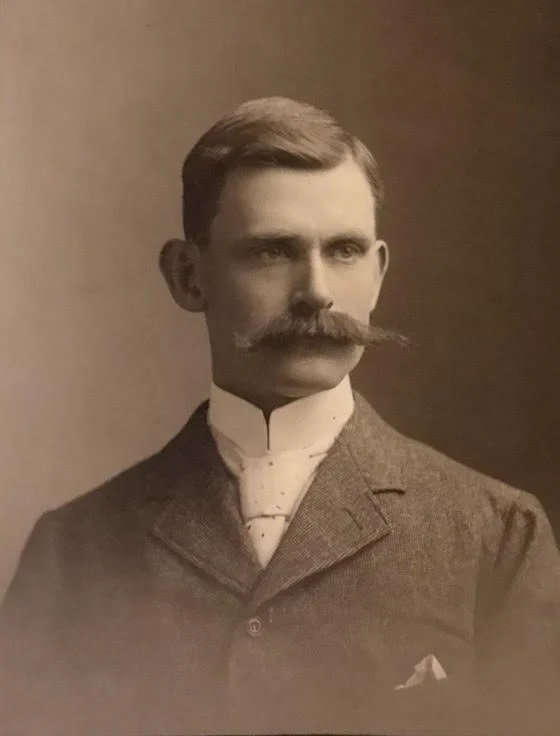
Portrait of Frederick T. Hallett
One Lodge, Six Charters / Advance Lodge No. 635
A life in Advance Lodge: Frederick T. Hallett, Astoria merchant and civic organizer.
Merchant, undertaker, Republican organizer and the 209th member of Advance Lodge No. 635, Frederick T. Hallett carried one of Astoria’s oldest names into the age of the Queensboro Bridge.
When Frederick T. Hallett knelt at the altar of Advance Lodge No. 635 in the spring of 1893, he was not entering unfamiliar rooms. His father, Charles W. Hallett, had been raised there eighteen years earlier, and his brother, Charles Wesley Hallett Jr., had followed in 1880. The family name was older than the lodge and older than Astoria itself, fixed to the shoreline at Hallett’s Cove. What Frederick added to it over the next eighteen years was something no map could record: a life spent at the center of nearly every institution his neighborhood depended on.
A Name Already on the Water
The Halletts arrived early. Brothers James and William Hallett settled in the area in 1653 and took up farms that covered nearly all of what later became Astoria and Steinway. The cove near Hell Gate took William’s name and kept it. Later generations turned to the trades. They were skilled cabinetmakers, and one served as the village wreckmaster; Frederick kept a bundle of receipts from 1813 recording schooners lost on that treacherous stretch of water.
Charles W. Hallett took over the family business in 1853, working first in cabinetmaking and upholstery before buying the hardware trade of a man named Blackwell. He became one of Astoria’s most successful merchants and served as an alderman of Long Island City. His son Frederick was born in Astoria on March 19, 1863, attended the old public school on what became Franklin Street and then the private schools favored by the village’s leading families, and went straight from the classroom into his father’s store. He never left it.
Hammers and Hearses
The Hallett enterprise was an odd pairing that made perfect sense in a growing community. By 1907 Frederick, now its head, ran a hardware, house-furnishing and storage business at 127 Main Street and an undertaking and livery establishment next door at Nos. 129 and 131. One side of the house sold nails, stoves and tools to the people building Astoria. The other side buried them.
That second trade put him inside his neighbors’ hardest days. When police found an unidentified woman dead in St. Michael’s Cemetery in 1905, her body was taken to the Hallett undertaking rooms. When George H. Payntar, a prominent Long Island City man, died in Massachusetts in 1910, it was Undertaker Hallett who met the remains at Grand Central and saw them home. A merchant who sold hardware in the morning and arranged funerals in the afternoon came to know a community in a way few politicians ever did.
The Young Gentleman of Woolsey Street
In November 1887 a Brooklyn paper admired the nearly finished Queen Anne house Hallett had built on the Woolsey Street waterfront, each room finished in a different pattern of hardwood, its grounds to be laid out as a model of landscape gardening. He had bought the lot to the north as well, so that no one could ever cut off his view up the Sound. He and his bride expected to move in by Christmas. She was Addie Sadtler of Baltimore, and the house above Hallett’s Cove remained the family home for the rest of his life.
The following September he rowed in the Astoria Athletic Club regatta off Steinway. In the single gigs he faced Henry C. Johnson Jr., who had never lost to a clubmate, and stayed even with him to the stake-boat before losing by four lengths. In the double sculls, he and Walter H. Muchmore dropped a hard-fought heat by a boat’s length. Supper and dancing followed until late. The club’s president that year was Edward J. Knauer, a past master of Advance Lodge, and the two men’s paths would keep crossing.
Addie Hallett lent her voice to the volunteer choir at the dedication of Astoria’s new Reformed Church in 1889. The family’s own church was the Astoria Presbyterian, where Frederick served as trustee and treasurer, and when its ailing pastor, the Rev. Clarence Geddes, was given a farewell reception in April 1893, the Halletts turned out in force.
Three Degrees in a Single Year
A month later, on May 23, 1893, Frederick T. Hallett received the Entered Apprentice degree in Advance Lodge at the age of thirty. He was passed to the degree of Fellow Craft on September 12 and raised a Master Mason on September 26, becoming the lodge’s 209th member.
He joined a lodge where his family already had standing. Charles W. Hallett had been made a Mason there in the winter of 1875, at forty-three, receiving his three degrees on January 26, February 9 and February 23 as the 107th member. Charles Wesley Hallett Jr. followed at twenty-two, initiated March 30, 1880, passed April 13 and raised April 27 as the 128th. In 1912 the line reached another generation when Howard L. Hallett, then twenty-three, received his degrees on September 17, October 15 and December 3 as the 505th member. Frederick had known him from boyhood. In 1904, when fourteen-year-old Howard’s bobsled slammed into a wagon at the foot of Presbyterian Hill and left him with a fractured skull, it was his uncle Frederick who hurried to the scene and carried him home in a coach.
Hallett did not stop at the Blue Lodge. He went on into Banner Chapter, Royal Arch Masons, and Columbia Commandery No. 1, Knights Templar, and carried the same habits of fellowship into Sunswick Council of the Royal Arcanum, Enterprise Lodge of the Knights of Pythias, John Allen Lodge of the Ancient Order of United Workmen, and Queensboro Lodge of Elks. He was a veteran volunteer fireman and the first treasurer of the Veteran Firemen’s Association of Long Island City.
The Lincoln Club Years
Politics was where his name appeared most often in print. A lifelong Republican, he was one of the first members of the Lincoln Club, the leading Republican organization in Queens, and served four years as its president. The club had weathered lean seasons, and when he stepped down at the start of 1901 he told the annual Lincoln’s Birthday banquet that it was out of debt with a surplus in the treasury. His successor, Postmaster George Ripperger, then presented him with a costly gold-headed cane.
He chaired the First Ward Republican General Committee, sat on the Queens County committee, and spoke for his ward at a stormy 1901 hearing on Assemblyman Eugene Vacheron’s bills to put the sheriff and county clerk on salary, registering the committee’s opposition. In 1902 he won county committee backing for a bill to reinstate firemen dismissed by Mayor Patrick Gleason, men he said had been fired out of political spite because Mayor Horatio Sanford had appointed them. Sanford, as it happened, had been raised a Master Mason in 1893, the same year as Hallett.
Office itself came close without quite arriving. In May 1899 the Lincoln Club pressed for his appointment as Queens County Commissioner of Jurors, and the papers reported the place as good as his; the appointing board named Edward Knauer instead, to the club’s loud indignation. In 1901 the Republican convention nominated Hallett for coroner, in an election his party lost that November. Friends later said he had declined chances at office more than once, believing a citizen could do his duty without holding one. As for Knauer, the two met again in a 1904 primary in Astoria’s Thirteenth District, and Hallett won it twenty-five votes to ten.
A Borough Under Construction
Consolidation in 1898 turned Long Island City from a small city into a ward of the metropolis, and Hallett spent his last decade working on what that change demanded. In December 1898, with a bridge over Blackwell’s Island finally looking likely, he was chosen temporary chairman of a meeting to organize a Board of Trade. In 1900 he sat on court-appointed commissions dealing with Jamaica’s water supply and its long-needed sewers. He was a charter member and first president of the Astoria Club, president of the Astoria Taxpayers’ Association, a member of the Committee of One Hundred on Transit of Queens, and from 1907 a member of the executive committee of the new Long Island City Business Men’s Association.
He brought a practical voice to those rooms. When sewers were debated in 1908, he spoke as a man who lived near one of the great outlets and insisted that every new sewer should empty into a disposal plant rather than the open water. In 1910 he joined Dr. Walter G. Frey and Francis G. Oakes on a committee examining Long Island City’s water supply. He spent days visiting every plant serving the section, and the report he helped write led the city’s Water Commissioner to approve extensive improvements for the ward.
The Great American Hen
The Queensboro Bridge was the event his generation had waited for, and Hallett served on the celebration committee for its opening in June 1909. That March he gave a Brooklyn reporter a theory of Queens growth that was half joke and wholly serious. Much of Long Island’s development, he argued, came from crowded city dwellers who wanted to keep chickens. Real estate men in Long Island City heard the same first question from nearly every buyer: “Can we keep chickens there?” Builders were adding coops to sell houses. Once the bridge opened, he predicted, the exodus from Manhattan would startle people.
Beneath the poultry lay a sharp observation. People would come to Queens for room: for gardens, yards and a domestic freedom the denser boroughs no longer allowed. He closed with a line no booster could improve on, promising that “the ring of the hammer, the cluck of the hen and the crow of the rooster will resound in the borough.” Coming from a man who sold hammers for a living, it read almost like an order placed in advance.
The Last Weeks of March
In March 1911 he entered St. Luke’s Hospital in Manhattan expecting a minor operation. The surgeons found his case critical and undertook a far more difficult one, and within days the Long Island City papers were reporting little hope. He died early on Sunday, March 26, 1911, of cancer of the stomach, at forty-eight. The funeral was held at his father’s house on Remsen Street. He left Addie, two sons and two daughters.
The Brooklyn Eagle said he was known by almost everybody and called him “a friend and loved companion of all who knew him.” Charles W. Hallett, who had brought him into both the business and the lodge, outlived him by three years.
The business outlived him as well. In 1912 Frederick T. Hallett, Inc. was incorporated with his widow, Adelaide, his brother Walter E. Hallett and Howard L. Hallett as directors, and the firm’s name was still appearing in the undertakers’ listings in 1919. That same autumn of 1912, Howard took his degrees in Advance Lodge.
The Line in the Ledger
Advance Lodge’s records give Frederick T. Hallett a single line as its 209th member, set between the entries for his father and brother and the one for Howard that came after. The newspapers fill in what that line leaves out: the regattas and banquets, the committee rooms and water plants, the hardware counter and the quieter work in the rooms next door. He was born to a name already on the map. He spent his life making sure the place it named was ready for the city coming across the bridge.
Endnotes and Sources
Author’s note:
I write as an individual Freemason, historian, and researcher. This article reflects my personal research and interpretation and does not represent an official statement of Advance Service Mizpah Lodge No. 586, the Grand Lodge of New York, or any other Masonic organization.
Images:
Portrait of Fred T. Hallett. author's collection.
Lodge Records
Advance Lodge No. 635, F. & A.M., Astoria, membership and degree records for Charles W. Hallett Sr. (107th member), Charles Wesley Hallett Jr. (128th), Frederick T. Hallett (209th) and Howard L. Hallett (505th), as examined by Brete Murphy.
Newspapers
Brooklyn Daily Times: November 30, 1887 (Woolsey Street residence); September 17, 1888 (Astoria Athletic Club regatta); October 4, 1888 (Astoria Athletic Club flag presentation); June 26, 1889 (Reformed Church dedication); January 13, 1893 (Queens County Republican Central Committee); April 20, 1893 (Geddes farewell reception); December 9, 1898 (Board of Trade meeting); March 31, 1899 (notaries appointed); May 19, 1899 (Commissioner of Jurors); January 25 and February 21, 1900 (social notes); June 16, 1900 (Republican National Convention delegates); February 13, 1901 (Lincoln Club dinner); February 25, 1901 (Vacheron bills hearing); April 8, 1901 (Lincoln Club committees); September 13, October 4, October 7, October 31, November 2 and December 11, 1901 (Republican affairs and coroner nomination); March 14, 1902 (Queens County Republican Committee); September 16 and December 11, 1903; January 19, 1904 (Presbyterian Hill bobsled accident); March 30 and August 25, 1904 (primaries); October 24, 1907 (Long Island City Business Men’s Association); August 13, 1908; December 4, 1908 (sewer debate); December 3, 1909 (transit); November 11, 1910 (water supply committee); March 24, 1911 (illness); April 7, 1918 (Hallett–Hodgetts wedding).
Brooklyn Daily Eagle: May 19, 1899; February 13, 1900; May 24, 1900 (Jamaica water and sewer commissions); February 24, 1901; January 27, 1902; February 4, 1903; April 4 and August 23, 1904; February 5, 1905; August 3, 1906; October 11, 1907; March 21, 1909 (“Great American Hen to Flourish in Queens”); June 12, 1909 (Queensboro Bridge celebration committees); November 11, 1910; March 27, 1911 (obituary); December 18, 1911 (Payntar estate claim); April 3 and April 10, 1912 (incorporation and mortgage); June 12, 1914 (will of Charles W. Hallett); April 7, 1918.
Brooklyn Citizen: May 23, 1899; December 12, 1900; March 24 and March 27, 1911.
Times Union (Brooklyn): February 24, 1894.
New-York Tribune: December 1, 1907 (“Man of Many Activities”); March 27, 1911 (obituary and death notice); February 2, 1919 (undertakers’ listings).
The New York Times: March 27, 1911.
Public and Organizational Records
- Articles of incorporation of Frederick T. Hallett, Inc., filed with the New York Secretary of State, 1912, as reported in the Brooklyn Daily Eagle.
- Will of Charles W. Hallett, Queens County Surrogate’s Court, 1914, as reported in the Brooklyn Daily Eagle.
A Note on the Sources
- Birth year: Hallett’s 1911 obituaries give March 19, 1862, while a 1901 profile gives March 19, 1863. His recorded age at initiation (thirty in May 1893) and at death (forty-eight in March 1911) both fit 1863, which this article follows.
- The Woolsey Street house number appears as both 131 and 113; contemporary notices also give differing numbers for his father’s Remsen Street home.
- Two obituaries name his commandery as Columbia Commandery No. 1; a third gives Trinity Commandery.
- Contemporary newspapers describe Howard L. Hallett as Frederick’s nephew.
Continue the Story
Frederick’s story belongs to a larger history of family, fellowship and the making of Astoria.
- Charles Wesley Hallett Sr. — Meet Frederick’s father, who preceded him in both the family business and Advance Lodge.
- Edward J. Knauer of Advance Lodge No. 635 — Follow another lodge brother through Astoria’s athletic clubs, politics and public life.
- Hell Gate and Hallett’s Point — Explore the waterfront setting behind the Hallett family name.
