Prometheus Is Not Only a Rebel
Forethought, fire, and the danger of power without wisdom
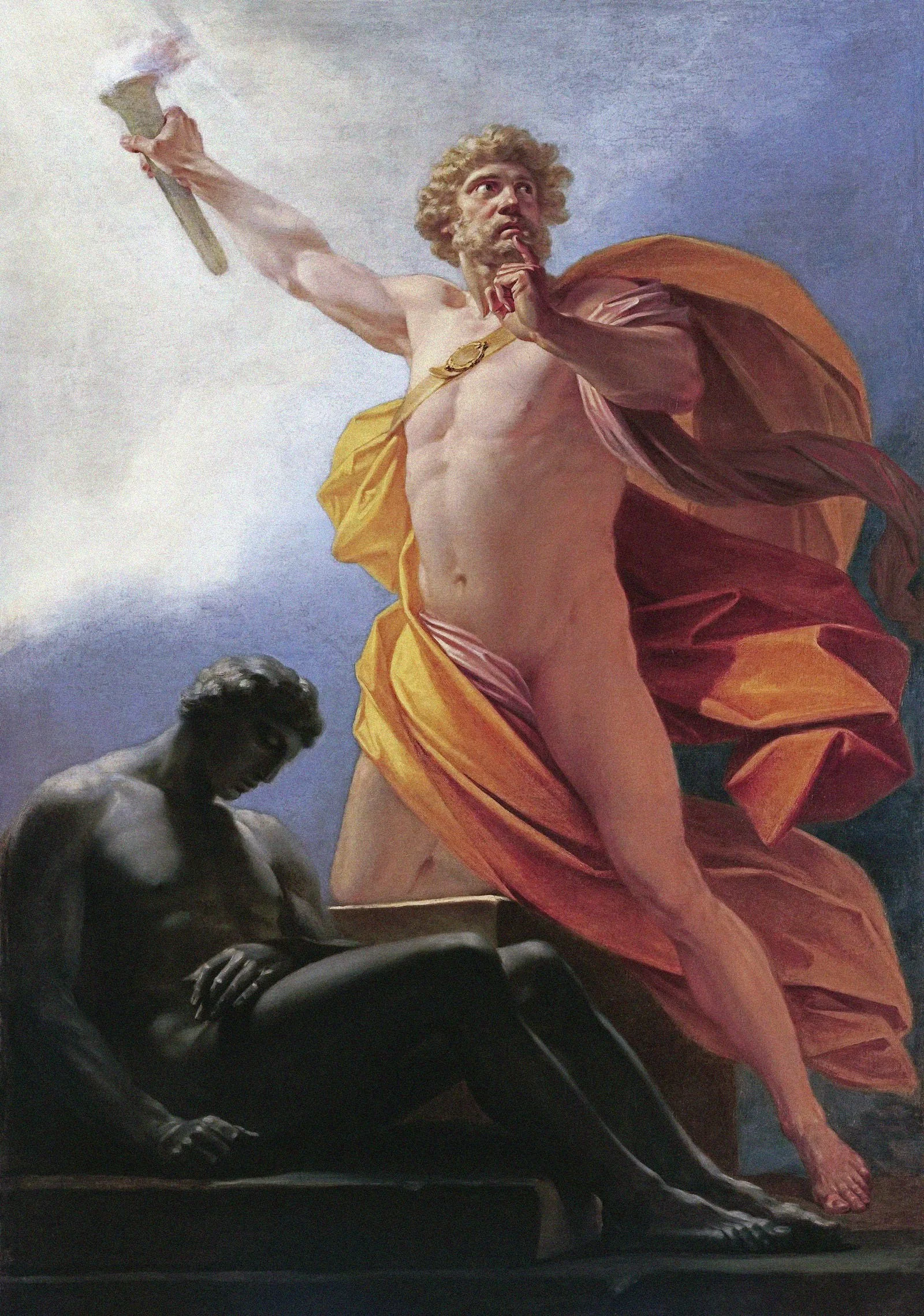
Prometheus is more than a defiant thief of divine fire. His name means Forethought. He represents the human capacity to anticipate, invent, build, and alter the world—along with the uncomfortable question of whether intelligence has learned what it is for.
Prometheus is often imagined standing dramatically against Olympus: a noble rebel, a bringer of fire, an enemy of tyranny, and the original patron saint of people who believe the rules are mostly for someone else.
There is truth in the image.
But it is not enough.
Prometheus is not merely rebellion. His name, Promētheus, means Forethought. He is the one who sees before. His brother Epimetheus is Afterthought—the person who understands the problem once the problem has become expensive.
This is a distinction with enduring relevance.
Forethought plans.
It anticipates.
It designs.
It imagines consequences.
It creates tools before the need arrives.
It sees that a human being can do more than survive the weather; he can build shelter, make fire, heal wounds, navigate water, remember through writing, count through number, and shape material into forms that endure.
Prometheus represents the astonishing power of human intelligence.
He also represents the danger that intelligence may become proud before it becomes wise.
The gift of fire
In Hesiod, Prometheus deceives Zeus at Mecone by arranging a sacrifice so that Zeus chooses the less desirable portion, then later steals fire for humanity after Zeus withholds it. The story is not simply about generosity. It is about rivalry, sacrifice, power, and the difficult relationship between gods and mortals.
Fire changes everything.
It cooks food. It gives warmth. It provides light. It transforms raw material. It permits craft. It creates the possibility of metallurgy, pottery, architecture, technology, and civilization.
But fire also burns.
It destroys homes, forests, bodies, cities, and boundaries.
The gift is never innocent merely because it is useful.
This is why Prometheus is a more complicated figure than a heroic benefactor. He gives humanity a power that expands its possibilities. The question becomes whether humanity can bear the power it receives.
This is the Promethean problem.
Can we make something without immediately asking whether we should?
Can we gain power without becoming servants of the power?
Can we invent a tool without allowing the tool to remake our desires?
Can we light a fire without forgetting that it can burn the house?
Forethought and the craftsman
Prometheus belongs naturally beside Daedalus.
Daedalus represents craft, architecture, invention, and the moral responsibility of building. Prometheus represents the larger human capacity to foresee, plan, invent, and give power to others.
Both myths ask whether technical intelligence is sufficient.
It is not.
A person may know how to design a system without knowing whether the system serves justice.
He may know how to persuade without knowing whether he should persuade.
He may know how to make something efficient without asking what human cost the efficiency conceals.
He may know how to gain influence without knowing what influence requires of character.
Forethought is a gift because it allows us to see consequences before they arrive.
But forethought can be corrupted.
It can become manipulation.
It can become exploitation.
It can become the cleverness that sees every person as an instrument and every moral limit as a problem to be solved.
The truly wise person does not merely ask, “What will happen?”
He also asks, “What ought to happen, and what will this make of us?”
The human fire
Prometheus’ fire can be read as more than literal flame.
It is every capacity that elevates human life beyond immediate animal need:
Language.
Memory.
Number.
Craft.
Medicine.
Law.
Art.
Architecture.
Navigation.
Education.
Moral reflection.
The ability to imagine a world different from the one presently given.
These are gifts.
They can free.
They can also bind.
A person may use language to tell truth or to manipulate. He may use memory to preserve wisdom or to cultivate grievance. He may use law to protect dignity or conceal injustice. He may use architecture to shelter or imprison. He may use education to awaken judgment or merely produce more efficient vanity.
The fire has no moral direction until the person holding it develops one.
The Masonic fire
Freemasonry honors human craft, architecture, geometry, and moral labor. It understands that the builder’s tools are not merely useful objects but images of discipline, measure, relation, and responsibility.
The Promethean question belongs naturally here.
What do we do with the tools we possess?
Do they make us more capable of service, justice, charity, and truth?
Or do they merely make us more capable of getting what we want?
The pursuit of Light can become Promethean in the wrong sense if it is treated as private power. The seeker begins to want knowledge because it makes him feel elevated above others. He seeks hidden meanings, titles, or authority without asking whether he has developed the moral strength to use them well.
Fire in untrained hands is dangerous.
So is knowledge without humility.
Forethought can give humanity fire.
Wisdom must still decide what humanity does with it.
Endnotes and further reading
Hesiod, Theogony 507–616, on Prometheus, Zeus, sacrifice, fire, and Pandora.
Hesiod, Works and Days 42–105, on the withholding of fire and the arrival of Pandora.
Aeschylus, Prometheus Bound, for the dramatic portrayal of Prometheus as benefactor, sufferer, and defiant foreseer.
Plato, Protagoras, on Prometheus, Epimetheus, and the distribution of human capacities.
Related reading: “Skill Is Not Wisdom” and “The Craftsman’s Responsibility.”