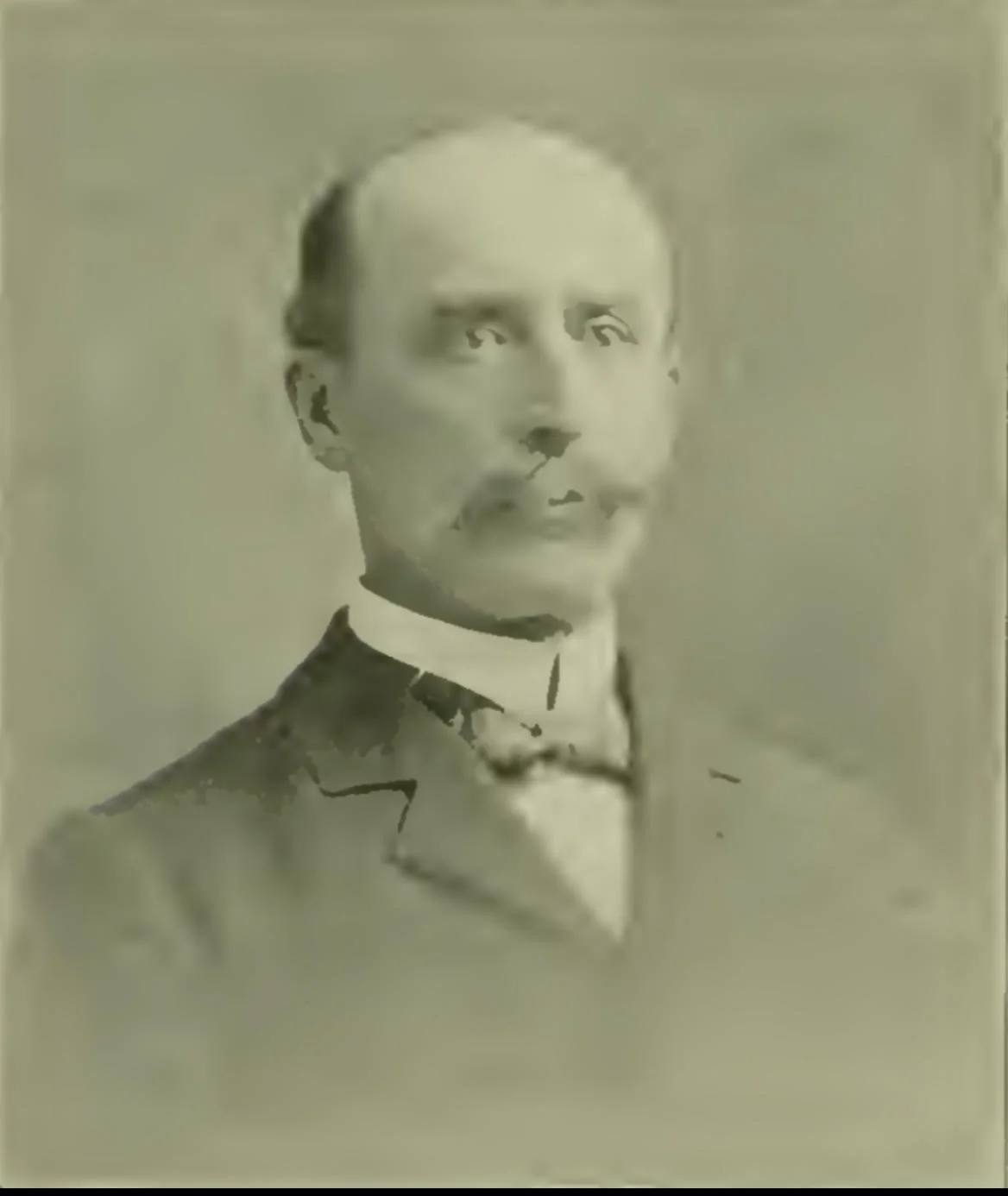
A baron's son and Franco-Prussian War veteran, Julius von Hunerbein was raised in Advance Lodge in 1883. He went on to draw Long Island City's official map, fight Mayor Gleason in court and serve as the first chief highway engineer of the new Borough of Queens.
The Grand Lodge entry is plain. On December 4, 1883, Advance Lodge No. 635 raised a 38-year-old surveyor living in Steinway. The name was not plain at all. Julius von Hunerbein was the second son of a Prussian baron, a former officer of the Guards and a veteran of the Franco-Prussian War. He had traded a commission for a transit and a German drill field for the unpaved streets of Long Island City. Within a few years his lines would be on the city's official map, and his name would be caught up in one of the bitterest political fights in the city's history.
From Jülich to the Guards
He was born on December 20, 1845, in Jülich, in the Rhenish province of Prussia, into an old German noble family. One obituary gave Berlin as his birthplace, but the fullest accounts agree on Jülich. He was educated at the military college in Berlin and commissioned an officer. He served in the Fourth Regiment of the Prussian Guards, and he took part in the Franco-Prussian War of 1870–71, the war that turned Prussia into the German Empire.
In October 1871 he married Louise Nollet of Hanover. Soon afterward he left Germany; accounts give his arrival in America as 1871 or 1872. He settled in Long Island City. He never seems to have considered living anywhere else.
A New Profession on New Ground
In Queens, the officer became a civil engineer and surveyor. It was a natural change for a man trained in fieldcraft, angles and maps, and Long Island City in the 1870s had endless work for anyone who could measure it. The city had been incorporated only in 1870 out of Hunters Point, Ravenswood, Astoria, Dutch Kills and the farms between them. Its streets existed mostly on paper.
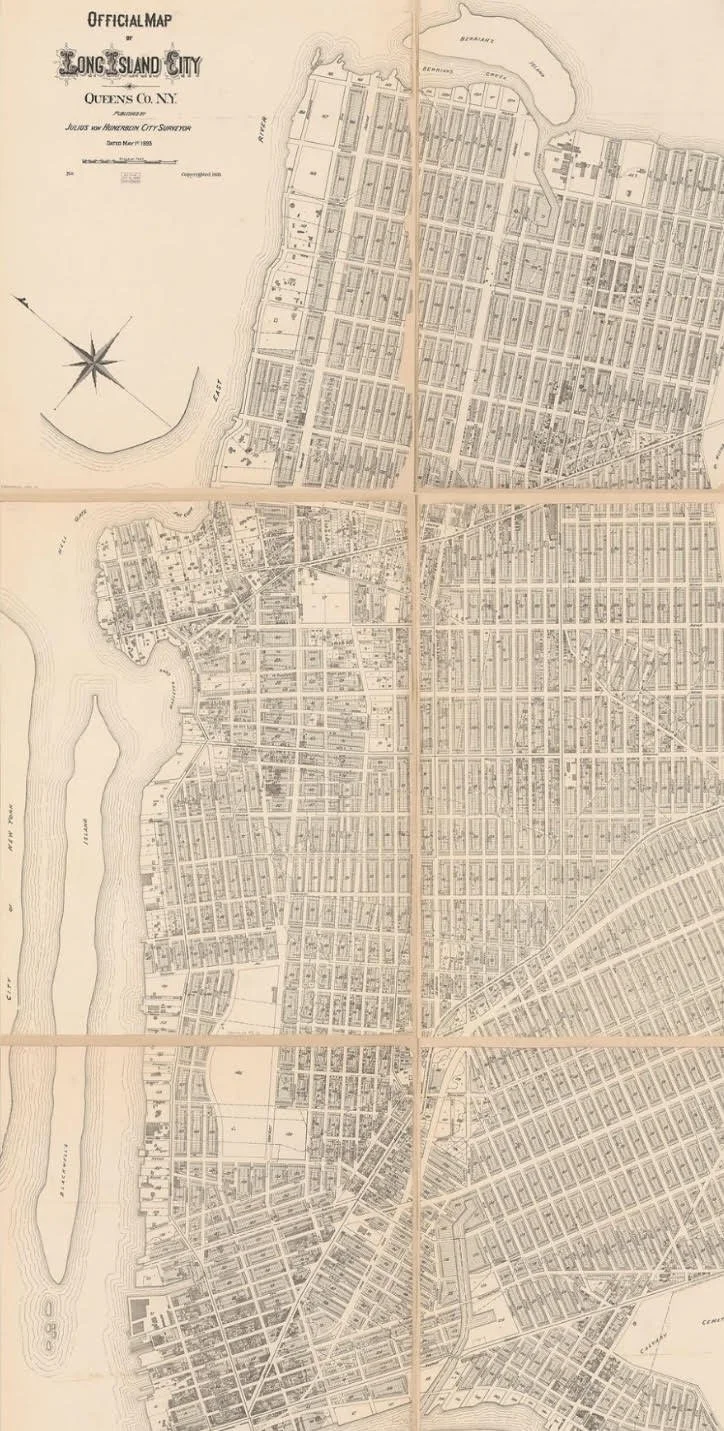
Von Hunerbein became engineer and surveyor to the city's Water Works Department and later to its General Improvement Commission, the body that laid trunk sewers and paved the streets. In the end he was chief engineer of both. He also served as City Surveyor, and in that office he produced the Official Map of Long Island City, Queens Co. N.Y.,
dated May 1, 1893. It is a cadastral sheet showing every lot line, block number and building in the city, and the Library of Congress holds a copy today. The map put him in the company of the few men who drew the city before consolidation. Peter G. Van Alst had made the city's first official map. Ernest Ankener would later triangulate all of Queens from his own tower. Von Hunerbein's map belongs on the same shelf.
Steinway's Engineer
He made his home in Steinway, the company village William Steinway had built around his piano works on the Astoria shore. The family lived at 274 Theodore Street. Von Hunerbein was described as an intimate friend of William Steinway, who was then the most powerful man in that part of Queens and one of the most prominent German-Americans in the country.
The friendship had a professional side. When the Steinway business was reorganized as a London-registered company in 1897, after William Steinway's death, the prospectus listed among the firm's chief assets its freehold properties in New York and Long Island City. The valuation of those properties was credited in part to Julius von Hunerbein, described as a well-known New York valuer.
His circle was German as well as local. He belonged to the Liederkranz of New York, the great German singing society, and to the German Krieger Bund, the association of veterans of the Franco-Prussian War. Kelsey's 1896 history
called him a "Jeffersonian Democrat." He and Louise raised four children: Helen, Elsie, Arthur and Melanie, who appears in later accounts as Ela.
A Brother in Advance
By the time he was raised in Advance Lodge in December 1883, von Hunerbein had lived in Long Island City for more than a decade. Advance was then sixteen years old and still meeting in rented rooms in Astoria, decades before its temple on Grand Avenue. Its members were the men who were building the city. Many of them were German-born, and many worked with stakes and maps. Within a few years the lodge would count engineers like Ankener and Frederick Skene among its members. Von Hunerbein was there earlier than either of them.
Caught Between Two Mayors
He was a firm Democrat, which in Long Island City was not a quiet affiliation. He appears in 1880 among the delegates chosen in the city's Democratic primaries. That world was dominated for years by Patrick J. "Battle-Axe" Gleason.
The collision came in the winter of 1895–96. Long Island City had two men claiming to be mayor: Horatio S. Sanford, the reformer, and Gleason, back from defeat and taking power again. The General Improvement Commission's employees had been reappointed under Sanford for another year. When Gleason's board took over, it suspended them all. Von Hunerbein was one of them, together with Assistant Engineer William Lutjens, Clerk Charles H. Smith and Rodman Richard Reynolds. Ernest Ankener was pushed out of the commission's top engineering job in the same weeks.
The men went to court. On January 30, 1896, Justice William J. Gaynor ordered the commissioners to reinstate Engineer Julius von Hunerbein and the others or show cause why they should not be compelled to. The papers noted that all of the plaintiffs were anti-Gleason men.
The First Highway Engineer of Queens
Consolidation in 1898 settled the matter in its own way. Long Island City disappeared into the Borough of Queens, and with it went the old commissions and their quarrels. Von Hunerbein went on into the new city's service as chief engineer in the office of the Deputy Commissioner of Highways for the Borough of Queens. He was the man responsible for the engineering of the borough's roads at the moment the borough was born.
He did not hold the post long. In November 1899 he bought a house on Fifth Street in Elmhurst and moved his family there. That same year his eldest daughter, Helen, was married from the Theodore Street house to William Elmer Annis. By early 1900 von Hunerbein was seriously ill. In March the papers reported him recovering, but he was not. He died at his Elmhurst home on Saturday, April 21, 1900, at 54.
The funeral was held at the house. The Krieger Bund and the Liederkranz were to attend in a body. He was buried in St. Michael's Cemetery, Astoria, the same ground where Ernest Ankener would be buried thirty years later.
The Officer's Map
The newspapers that reported his death led with his birth: the baron's son, the officer of the Guards. Those facts made good copy, but they were not why Long Island City had kept him for nearly thirty years. The city kept him because he could survey a street, run a waterworks and draw a map that others could build on.
He reached Advance Lodge after a long road that ran through the Prussian Guards and the war of 1870. He came to it as a surveyor from Steinway, and the record of his raising in Advance Lodge No. 635 calls him just that.
Endnotes
Grand Lodge of the State of New York membership records, Advance Lodge No. 635: Julius von Hunerbein, raised December 4, 1883, age 38, surveyor, residence Steinway. Examined by Brete Murphy.
J. S. Kelsey, History of Long Island City, New York: A Record of Its Early Settlement and Corporate Progress (Long Island City: Long Island Star Publishing Co., 1896), biographical sketch, p. 194; transcription at LDS Genealogy;
[scan at the Library of Congress](History of Long Island City, New York. A record of its early settlement and corporate progress. Sketches of the villages that were absorbed in the growth of the present municipality. Its business, finance, manufactures, and form of government, with s
History of Long Island City, New York. A record of its early settlement and corporate progress. Sketches of the villages that were absorbed in the growth of the present municipality. Its business, finance, manufactures, and form of government, with s Also available in digital form.
- Julius von Hunerbein, City Surveyor, Official Map of Long Island City, Queens Co. N.Y.,
dated May 1, 1893, Library of Congress Geography and Map Division. 4. "Obituary—Long Island: Arthur von Hunerbein [Julius Arthur von Hunerbein]," Brooklyn Eagle, April 25, 1900, p. 13.
"Obituary," Long Island City, April 24, 1900 (Julius von Hunerbein).
Marriage notice, Helen von Hunerbein and William Elmer Annis, of 274 Theodore Street, Steinway, 1899.
"Prospectus of New Concern" (Steinway & Sons), New York Times, August 20, 1897, p. 1.
"Want Their Old Jobs Again: Discharged Employes Get an Order from Justice Gaynor," New York Times, January 31, 1896, p. 16; "Struggling Against Gleason: Men Whom He Discharged Get an Order from Judge Gaynor," Brooklyn Eagle, January 1896.
"Personal," Brooklyn Daily Times, March 1, 1900, p. 9.
"Madden Still the Leader," Brooklyn Eagle, 1880, p. 3 (Democratic primary delegates, Long Island City).
Related reading: Ernest Ankener · Peter G. Van Alst Jr. · Frederick Skene · Advance Lodge No. 635 History
← Peter G. Van Alst Jr.: Astoria Surveyor of Advance Lodge No. 635 | Advance Lodge No. 635 Members Directory | One Lodge, Six Charters: Start Here
