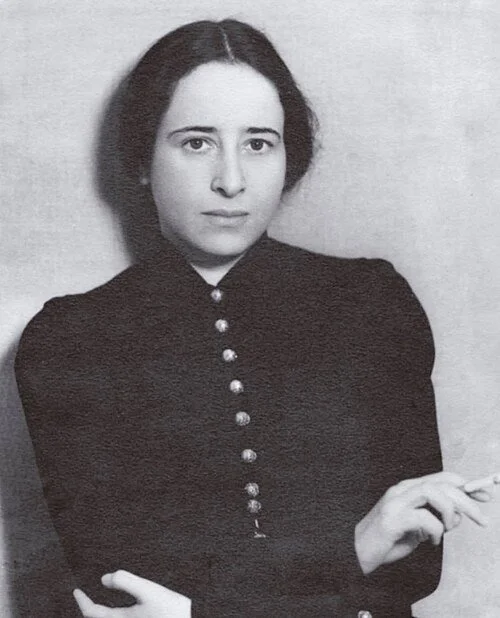
Hannah Arendt and the Banality of Evil
Evil is not always theatrical. Sometimes it appears in the form of thoughtlessness: the failure to judge, the refusal to reflect, and the quiet habit of doing as one is carried along.
Some ideas remain disturbing because they resist melodrama.
Hannah Arendt’s phrase “the banality of evil” is one of them.[1] It is often misunderstood as a denial of evil’s seriousness, as if to call evil banal were to call it small. Arendt meant almost the opposite. Her point was that evil need not arise only from monstrous passions or diabolical genius. It can also proceed through ordinary thoughtlessness, through a person who ceases to examine what he is doing and becomes content to function within an accepted system.
That possibility is harder to bear than a simpler story.
It implicates more of us.
Writing about Adolf Eichmann, Arendt was struck not by demonic depth but by shallowness — by clichés, stock phrases, bureaucratic habits, and the evident inability or unwillingness to think from the standpoint of another.[2] The scandal was not that evil had become less evil. It was that great evil could be carried forward by a man who seemed terrifyingly normal in certain respects.
He was not empty of intelligence.
He was empty of reflection.
This distinction matters.
Thoughtlessness, in Arendt’s sense, is not mere absentmindedness. It is a moral and intellectual failure to stop and judge. It is the surrender of inward dialogue, the collapse of the habit by which a person asks whether what is being done can be defended, whether the words being used conceal reality, whether obedience has become participation in wrong. Without that habit, normal function can become morally disastrous.
Arendt’s insight belongs naturally beside the liberal arts.
Grammar teaches one to hear when language has been standardized into euphemism. Logic trains one to test whether justifications actually justify. Rhetoric reveals how official speech can normalize the intolerable. History lengthens perspective. Philosophy keeps alive the elementary but difficult question: what is one doing?
These disciplines do not guarantee virtue.
But they do make thoughtlessness harder to excuse.
So does Masonry, if taken seriously.
Freemasonry presents itself as a school of moral and symbolic formation. It asks the initiate not merely to comply with forms but to reflect on them, to examine himself, and to become answerable for his conduct. That project fails when ritual is reduced to repetition and moral language to ornament. A man can move through inherited forms without ever letting them interrogate him. Arendt’s warning suggests how dangerous such inward passivity can become.
The point is not to compare every social failing to totalitarian crime.
It is to notice the mechanism.
Whenever people cease to judge for themselves, rely on prefabricated phrases, and treat responsibility as something diffused through procedure, they become more available to wrongdoing than they imagine. The scale may vary enormously. The principle does not. A person who trains himself not to think clearly about small matters should not be too confident about how he will behave in larger ones.
Arendt also clarifies why conscience cannot be outsourced. Institutions may be necessary, and procedures may be useful, but neither can substitute for judgment. One may obey regulations and still cooperate with what is morally rotten. One may speak the accepted language and still be hiding from reality. The decisive question remains whether the person has preserved the interior activity of thinking.
For Arendt, thinking was not mere data processing.
It was a dialogue with oneself.[3]
That description is especially important now. Many people are highly stimulated but rarely reflective. They react constantly and examine rarely. They can retrieve opinions instantly and feel them intensely, yet remain oddly unpracticed in the silent labor of judgment. This creates a culture that is informed in fragments and shallow in conscience.
The Masonic task should cut against that trend.
A lodge worth the name ought to cultivate men who can pause before repeating, who can judge before conforming, and who can detect the deadening effects of cliché in both public and private speech. It should encourage enough inward seriousness that symbols become provocations to thought rather than decorations of identity.
Arendt’s phrase endures because it strips away flattering assumptions. Many prefer to imagine evil as something committed only by obvious villains who stand at a dramatic distance from ordinary life. But if thoughtlessness itself is dangerous, then the first line of defense is neither indignation nor self-congratulation.
It is reflection.
The disciplined habit of stopping to ask:
What am I doing?
What is being done in my name?
What do these words conceal?
What would it mean to judge this honestly?
Those questions do not make a man heroic.
They do make him less available.
And in times of pressure, that may be one of the most important moral achievements a person can manage.
Endnotes
[1] Hannah Arendt, Eichmann in Jerusalem: A Report on the Banality of Evil.
[2] Arendt’s account of Eichmann emphasizes cliché, administrative mentality, and the failure of reflective judgment, not the triviality of evil itself.
[3] For Arendt’s account of thinking and its relation to judgment and conscience, see The Life of the Mind.
Brief Bibliography
Hannah Arendt, Eichmann in Jerusalem
Hannah Arendt, The Life of the Mind
Hannah Arendt, Responsibility and Judgment
Elisabeth Young-Bruehl, Hannah Arendt: For Love of the World