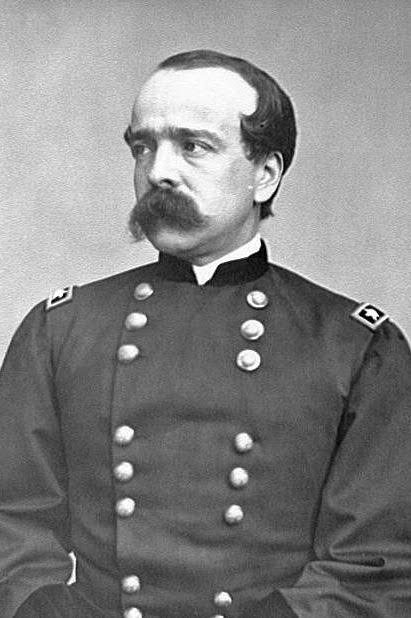
Gen. Daniel Adams Butterfield, associated with the familiar arrangement of Taps. U.S. Army image
By Brete Murphy · November 12, 2026
Notable Members · The Seven Lodges
He was an express-company executive, a Medal of Honor general and an organizer of military signals. His public career also carried the stain of the Black Friday gold scandal. Through Metropolitan Lodge No. 273, his Masonic history connects with the number Francis Lewis Lodge carries today.
Francis Lewis: Start Here · Historical Members Directory · The Seven Lodges
The twenty-four notes of Taps belong to the American language of remembrance. They close the military day and accompany the burial of the dead.
The general associated with their familiar arrangement, Daniel Butterfield, was also a member of Metropolitan Lodge No. 273 in Manhattan. That lodge’s number survives in Francis Lewis Lodge No. 273, connecting a nineteenth-century soldier’s Masonic affiliation with a continuing Queens District institution.
It is an institutional connection, not evidence that Taps originated in a lodge room or carried a Masonic meaning.
Butterfield’s life needs no such embellishment. He was a soldier of demonstrated courage, an energetic administrator and a man whose public service coexisted with serious scandal. His story moves from the stagecoach routes of antebellum America to the battlefields of Virginia, the gold market of Wall Street and a house overlooking the Hudson.
At its center is a recurring concern: how to make a signal understood.
The Stagecoach Heir
Daniel Adams Butterfield was born in Utica on October 31, 1831, into the family of John and Malinda Baker Butterfield.
His father was a transportation entrepreneur whose business interests helped establish American Express. John Butterfield’s Overland Mail enterprise later carried mail between the Mississippi Valley and California.
Daniel grew up in a world organized around routes, schedules and the movement of people and goods.
He graduated from Union College in 1849 and belonged to the Sigma Phi Society. In [Jari Villanueva’s biographical account](Daniel Adams Butterfield - Taps Bugler: Jari Villanueva
Daniel Adams Butterfield - Taps Bugler: Jari Villanueva By Tapsbugler
DANIEL ADAMS BUTTERFIELD 1831-1901 Who was the general whose name is associated with Taps? Daniel Adams Butterfield was born in Utica, New York, on October…
the young Butterfield appears as both a capable student and a mischievous, restless figure.
That account also describes a troubling episode in Utica: an arson indictment in 1851, based on a statement by a condemned man. The charges against Butterfield were dropped in 1853. An indictment is not a conviction, and the episode should not be presented as proof that he set the fires.
Travel and business followed. He visited Minnesota Territory and New Orleans, later recalling that his observations of slavery helped shape his political convictions.
Back in New York, he entered the family transportation business. He eventually became eastern superintendent of American Express.
A Young Manhattan Lodge
Villanueva’s biography records that Butterfield applied for membership in Lodge No. 273 in May 1854.
Masonic biographical accounts identify his lodge as Metropolitan in New York City. The precise dates of his degrees remain to be established from the lodge’s original records. The application date should not be substituted for an initiation or raising date.
Metropolitan itself was young. According to the Grand Lodge chronology compiled for this series, it received its charter on December 9, 1852.
Its founding group included men who had departed from Atwood Lodge No. 208. That relationship belongs to Metropolitan’s origin story; Atwood’s warrant continued separately.
Butterfield therefore entered a recently organized Manhattan institution, not a lodge founded for Civil War veterans or military officers.
His membership later became part of a lineage extending well beyond the halls in which Metropolitan first met.
Read Metropolitan Lodge No. 273 →
Read Francis Lewis’s Historical Members Directory →
From Business to Military Command
Butterfield’s business responsibilities developed alongside militia service.
He served in the 71st New York State Militia and later commanded the 12th New York militia regiment. In 1857, he married Elizabeth Brown.
When the Civil War began, his regiment went to Washington. On May 24, 1861, it participated in the Union advance into Alexandria, Virginia.
American Express continued supporting its superintendent. Villanueva’s account records an August 1861 notification that the company would maintain Butterfield’s full salary during the war.
By September, he was a brigadier general of volunteers.
His rise brought larger responsibilities, but his reputation would depend on more than administration.
Gaines’ Mill
At Gaines’ Mill, Virginia, on June 27, 1862, Butterfield seized the colors of the 83rd Pennsylvania Volunteers and encouraged its depleted ranks under enemy fire.
The act eventually earned him the Medal of Honor.
The [Congressional Medal of Honor Society’s recipient record](View All Medal of Honor Recipients | Congressional Medal of Honor Society
View All Medal of Honor Recipients | Congressional Medal of Honor Society
identifies the action and reproduces the citation. The award was issued on September 26, 1892, thirty years after the battle.
That delay separates the event from its formal recognition. Butterfield’s courage belonged to the fighting of 1862; the medal came much later.
After the Seven Days Battles, the Army of the Potomac withdrew to Harrison’s Landing on the James River.
There, amid the exhaustion of the campaign, Butterfield became associated with a different kind of military signal.
Twenty-Four Notes at Harrison’s Landing
Butterfield understood the practical importance of bugle calls. He had already developed a distinctive brigade call so that his men could recognize orders intended for them.
In July 1862, he worked with Oliver Willcox Norton, a bugler of the 83rd Pennsylvania, on a replacement for the regulation call used to extinguish lights.
The best-known account comes from correspondence written decades afterward.
In 1898, Norton recalled being summoned to Butterfield’s headquarters and asked to play a melody. Butterfield adjusted the lengths of notes until the result satisfied him. Norton then sounded the call for the brigade.
According to Norton, buglers from neighboring brigades soon asked for copies.
Butterfield’s own response broadly confirmed the episode but differed on details. He said he could sound bugle calls but could not write music, and described arranging the call by ear.
The two recollections are reproduced in [Villanueva’s history of Taps](An Excerpt From Twenty-Four Notes That Tap Deep Emotions: The story of Americas most famous bugle call - Taps Bugler: Jari Villanueva
An Excerpt From Twenty-Four Notes That Tap Deep Emotions: The story of Americas most famous bugle call - Taps Bugler: Jari Villanueva By Tapsbugler
An Excerpt From Twenty-Four Notes That Tap Deep Emotions:The Story of America’s Most Famous Bugle Call© Jari Villanueva You can download the REAL story of…
They are valuable testimony, but they are retrospective accounts rather than a diary entry written on the night itself.
An Adaptation, Not a Melody from Nothing
Villanueva’s musical research identifies the earlier Scott Tattoo as the source from which Butterfield’s arrangement developed.
The distinction is important. The familiar Taps did not emerge without a musical predecessor.
Butterfield helped reshape an existing call, and Norton helped give that arrangement its sounded form.
That does not diminish the achievement. A military signal became more memorable through selection, phrasing and performance.
Nor does the number of notes establish a Masonic connection. Nothing in the evidence presented here shows that Butterfield selected twenty-four notes for a fraternal reason.
From Lights Out to a Final Farewell
Taps began as an end-of-day signal. Its association with funerals developed into another use.
The traditional early account concerns Captain John C. Tidball, who had the call sounded over a soldier’s grave rather than risk drawing enemy attention with the customary rifle volleys.
Villanueva discusses that episode in his [Butterfield biography](Daniel Adams Butterfield - Taps Bugler: Jari Villanueva
Daniel Adams Butterfield - Taps Bugler: Jari Villanueva By Tapsbugler
DANIEL ADAMS BUTTERFIELD 1831-1901 Who was the general whose name is associated with Taps? Daniel Adams Butterfield was born in Utica, New York, on October…
It is best described as the traditional account of an early funeral use, rather than an occasion documented here as the indisputable first.
The practice eventually entered regulation. Villanueva identifies the Army’s 1891 infantry drill regulations as an early official requirement for Taps at military funerals.
The call’s emotional reach grew from that double purpose: rest at the end of a day and remembrance at the end of a life.
Badges, Manuals and Recognition
Butterfield’s interest in recognizable signals extended beyond music.
As chief of staff of the Army of the Potomac under Joseph Hooker in 1863, he developed a system of distinctive corps badges, building on an earlier identification practice associated with Philip Kearny.
Shapes distinguished corps. Colors distinguished divisions.
The purpose was practical: soldiers and officers needed to recognize commands in an army whose size made personal familiarity impossible.
The Fifth Corps used a Maltese cross. Villanueva’s account connects Butterfield’s choice with an earlier use of the shape for medals associated with his militia regiment.
There is no need to infer a Masonic explanation for the design.
Butterfield also prepared Camp and Outpost Duty for Infantry, published during the war. Like the badges and bugle signals, the manual belonged to the work of making military life more orderly and intelligible.
He remained chief of staff when George Meade succeeded Hooker and was wounded during the July 3, 1863 cannonade at Gettysburg.
Later service took him to the western theater.
Black Friday
Butterfield’s military record did not protect his later public career from disgrace.
In 1869, he became Assistant Treasurer of the United States in New York, a position connected with government gold sales.
Jay Gould and James Fisk were attempting to corner the gold market. Advance knowledge of Treasury action could give their scheme a decisive advantage.
PBS’s account of Black Friday describes Butterfield’s agreement to provide information about government gold sales in return for a share in the venture.
On September 24, 1869, the government’s intervention broke the corner and sent gold prices tumbling.
Butterfield lost his Treasury position in the scandal’s aftermath.
His role should not be reduced to unfortunate acquaintance with unscrupulous men. The historical account concerns the misuse of a public position and privileged information.
The courage recognized at Gaines’ Mill and the conduct associated with Black Friday belong to the same biography. Neither cancels the other.
Cragside
Butterfield later returned to business and became involved in financial, transportation and property enterprises.
He also organized public ceremonies, including arrangements associated with General William Tecumseh Sherman’s funeral in 1891.
His first wife died in 1877. In 1886, he married Julia Lorillard James in London.
They made their home at Cragside in Cold Spring, overlooking the Hudson River near West Point.
A frequently repeated story places Butterfield there in the evening, hearing Taps carried across the water from the academy.
It is an evocative tradition, recorded in the biographical literature. It should remain a story attributed to that literature, rather than a scene reconstructed as if someone had recorded each detail.
Butterfield died on July 17, 1901.
By special authorization, he was buried at West Point, although he had never attended the academy. Taps was sounded at his funeral.
His wife later compiled A Biographical Memorial of General Daniel Butterfield, published in 1904.
The Lodge Number That Continued
Metropolitan’s history did not end with Butterfield.
According to the Grand Lodge chronology compiled by Brete Murphy, Metropolitan combined with Whitestone on December 21, 1972.
Metropolitan-Whitestone and Bayside became Francis Lewis Lodge No. 273 on August 14, 1986. Brandeis joined the continuing line in 2015.
The author’s November 2026 account places Francis Lewis in College Point, where it began meeting in September 2025.
The connection to Butterfield is therefore one of institutional succession. He belonged to Metropolitan, not to the later lodge under the Francis Lewis name.
That distinction makes the inheritance clearer rather than weaker.
Read The Number That Traveled East →
Read Where the Lines Meet: The College Point Temple →
The Last Call
Butterfield’s place in this series rests on a documented lodge affiliation and the institutional history that followed it.
Taps adds another dimension, but not a claim of Masonic authorship.
Its familiar form emerged through an older musical tradition, Butterfield’s ear and Norton’s bugle. Its later meaning grew through repeated use by people far removed from the camp where the arrangement first sounded.
The result outlasted its arranger’s military appointments, business ventures and public disgrace.
For the history carried by Lodge No. 273, Butterfield remains a complicated figure: brave, capable, ambitious and compromised.
The signal is simpler than the man.
Sources and Research Notes
Image:
“Daniel Butterfield.jpg,” portrait of Daniel Adams Butterfield. The supplied file description attributes the image to the U.S. Army and gives July 4, 1862, as its original date notation. It identifies the image as an official-duty work of a U.S. Army soldier or employee and therefore public domain in the United States.
Taps and Butterfield’s Biography
Jari Villanueva, “Daniel Adams Butterfield, 1831–1901,” TapsBugler.
Used for the family and business background, the reported May 1854 lodge application, militia service, later career, marriages, Cragside tradition and burial.
The biographical narrative contains a chronological inconsistency concerning his military resignation and Treasury appointment. This article does not repeat that sequence.
Butterfield and Norton’s Recollections
Reproduces the 1898 Norton and Butterfield correspondence and explains the relationship between Taps and the earlier Scott Tattoo.
The letters are later recollections. Their differences are acknowledged rather than combined into a single supposedly contemporary account.
Medal of Honor
[Congressional Medal of Honor Society: Daniel Adams Butterfield](View All Medal of Honor Recipients | Congressional Medal of Honor Society
View All Medal of Honor Recipients | Congressional Medal of Honor Society
The recipient record identifies Gaines’ Mill, June 27, 1862, and the September 26, 1892 award date.
Black Friday
PBS, American Experience: “Black Friday, September 24, 1869”.
Used for Butterfield’s connection with the Gould-Fisk gold scheme and the consequences of government intervention.
Metropolitan Membership
[Masonry Today: “Daniel Adams Butterfield Is Born”](Today in Masonic History -
Today in Masonic History - Today in Masonic History provides information about events in history tied to the oldest fraternal organization in the world, Freemasonry.
Identifies Butterfield as a member of Metropolitan Lodge No. 273 in New York City.
Villanueva separately records a May 1854 application to Lodge No. 273.
The exact initiation, passing and raising dates remain to be established from Metropolitan’s original records. The application date is not presented as a completed degree date.
The broader appendant-body affiliations listed in earlier drafts are omitted here pending precise supporting citations.
Lodge Succession and the Queens Connection
Grand Lodge of New York records as compiled by Brete Murphy.
See:
- Metropolitan Lodge No. 273.
- Whitestone Lodge No. 973.
- Bayside Lodge No. 999.
- Francis Lewis Lodge No. 273: Main History.
- Francis Lewis: Historical Members Directory.
The consolidation chronology and present meeting-place account follow the author’s compilation and confirmations.
Metropolitan Lodge No. 273 · Francis Lewis: Historical Members Directory · Francis Lewis: Start Here
Notable Freemasons of Queens · The Seven Lodges: Series Guide · Connecting Stories

